Tax Filing and Tax System in Japan - Tax Essentials Every Foreign Professional Must Know

2026.06.22

  • Career Advice
日本の確定申告と税制――外国籍プロフェッショナルが押さえるべき税務の基本

For foreign professionals in Japan, taxes are not just 'what gets deducted from your paycheck'. Your residence classification determines your tax scope, and side income or medical expenses may require you to file a tax return.

More critically, proper tax payment directly affects your PR application. Ignoring taxes can have career-ending consequences.

This article covers the complete tax picture, when you need to file, and how to avoid overpaying.
How your residence status changes your tax scope


3 Residence Categories

Permanent Resident (non-NPR)10+ years in Japan or Japanese national. ALL worldwide income taxed
Non-Permanent Resident (NPR)Non-Japanese, in Japan 5 years or less in last 10. Domestic income + overseas income remitted to Japan taxed
Non-ResidentNo address in Japan or under 1 year. Only domestic-source income taxed at flat 20.42%

Most foreign professionals are classified as NPR for their first 5 years. Overseas investment or rental income is not taxed unless remitted to Japan. After 5 years, worldwide income becomes taxable.
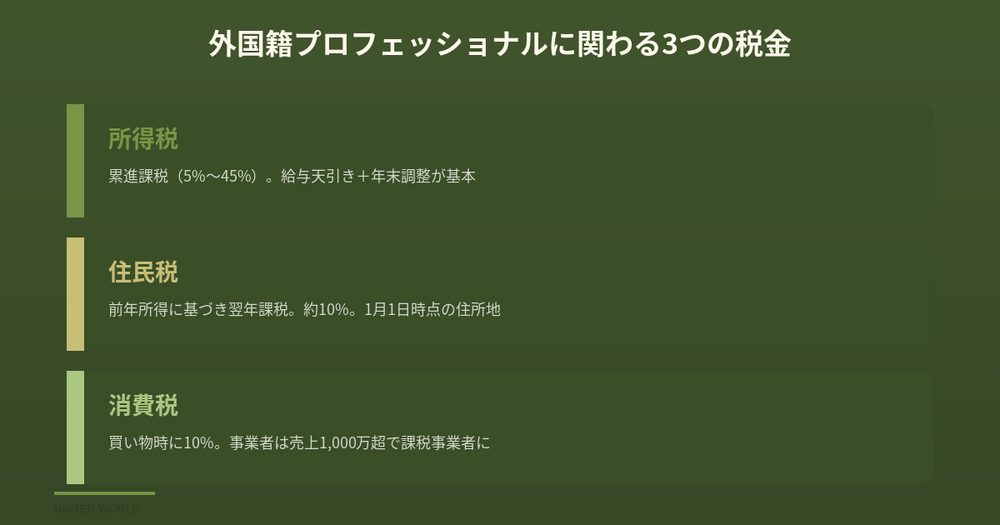
3 taxes you need to understand


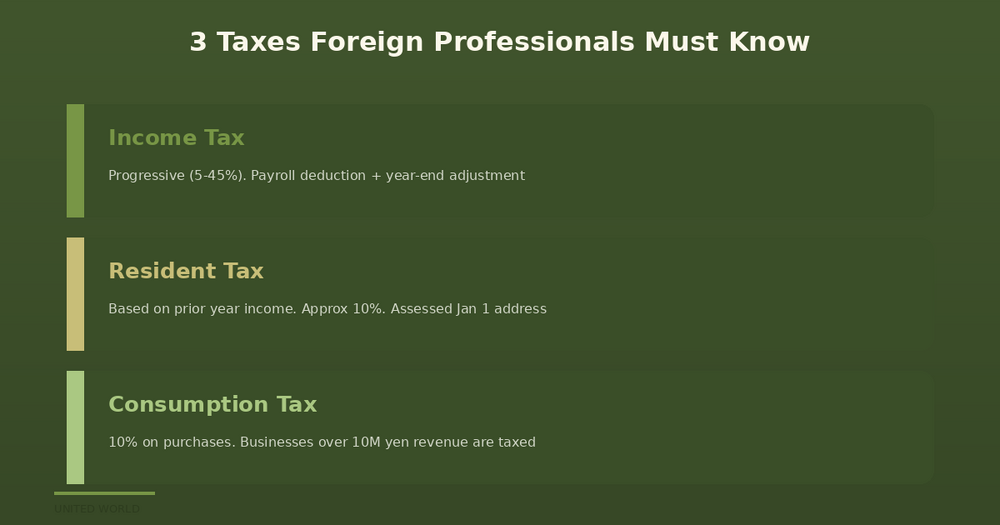
1. Income Tax

Progressive: 5% to 45% + 2.1% reconstruction surtax.
- Under 1.95M: 5% / 3.3M-6.95M: 20% / 9M-18M: 33% / Over 40M: 45%
- For employees: withheld from salary + year-end adjustment
- Deductions not handled by year-end adjustment require a tax return

2. Resident Tax

Based on prior year income. Collected June to May the following year.
- Flat rate approx 10% (6% municipal + 4% prefectural)
- Assessed based on address as of January 1
- Payroll deduction is standard. When leaving Japan, pay balance or appoint a tax rep

3. Consumption Tax

For daily purchases: 10% (8% on food).
- Salary earners generally have no consumption tax obligation
- Freelancers with revenue over 10M yen become taxable businesses

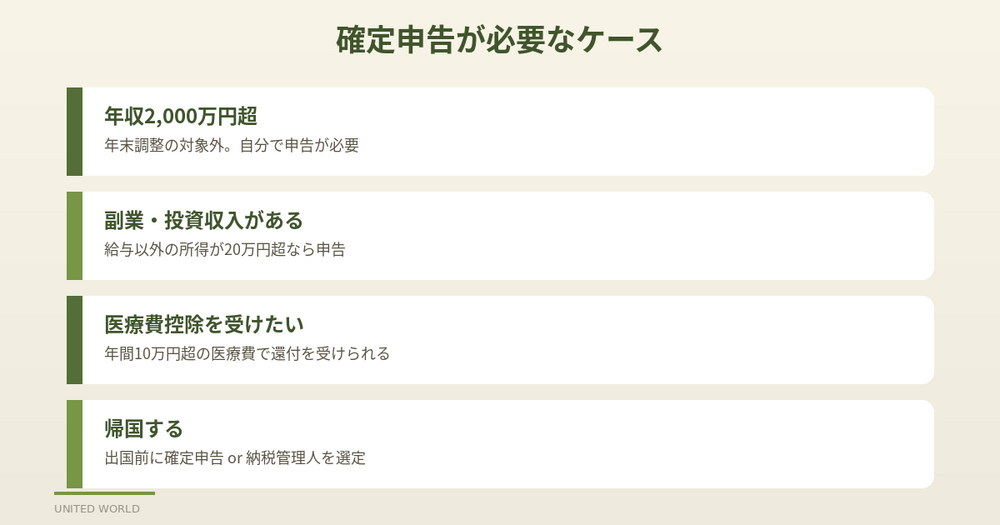
When you need to file a tax return


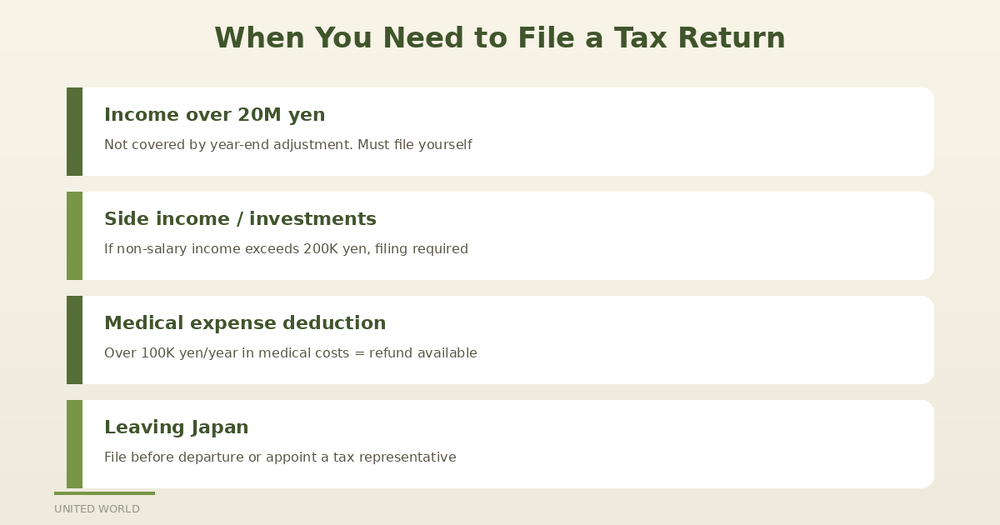
Employees normally finish with year-end adjustment, but these cases require filing:

Income over 20M yenNot covered by year-end adjustment
Side income over 200K yenNon-salary income (freelance, investments, rental) exceeding 200K yen
Multiple employersIf secondary salary exceeds 200K yen
Medical expense deductionAnnual medical costs over 100K yen (or 5% of total income) = refund available
Leaving JapanFile before departure or appoint a tax representative
Filing period: February 16 to March 15 each year.
- NTA 'Tax Return Preparation Corner' (online) has English manual
- e-Tax (electronic filing) available
- If unsure, consult a tax accountant (tens of thousands of yen)

Deductions foreign professionals should use


Using deductions can get overpaid taxes refunded.

Dependent deductionFamily abroad (spouse, children, parents) qualify if remittance is documented
Medical expense deductionMedical costs paid overseas also qualify
Social insurance deductionHealth insurance and pension premiums are fully deductible
Life insurance deductionOnly Japanese insurance companies qualify (overseas policies excluded)
Note:
- Non-residents can only apply basic deduction and donation deduction
- Overseas family members require marriage certificates and remittance proof
- Deductions missed in year-end adjustment can be claimed via tax return

The critical link between taxes and PR


As covered in Article 16, proper tax payment is one of the most critical PR screening factors.

Tax and PR:
- Even 1 day of late payment increases rejection risk
- PR revocation system (2027) targets deliberate non-payment
- MyNumber data sharing begins 2026+
- Payroll deduction (special collection) eliminates late payment risk
- Watch out for self-payment periods between jobs
Strategies:
- Choose a company with payroll deduction
- Pay remaining resident tax in full when changing jobs
- Check payment status via eLTAX
- Never miss the tax return deadline (penalties apply)

Summary: Make taxes work FOR your career


Income TaxProgressive 5-45%. Year-end adjustment. Over 20M = file yourself
Resident TaxPrior year income x approx 10%. Jan 1 address. Careful when leaving
Tax ReturnNeeded for side income 200K+, medical deductions, departure. Feb 16-Mar 15
PR ConnectionLate tax payment = top PR rejection factor. Payroll deduction is safest

Taxes are not a burden - they are an investment in protecting your career. Proper payment opens the door to PR. Using deductions increases your take-home pay. If unsure, consult a tax accountant or your recruitment agent.


Looking for a company with proper tax compliance?

United World Inc. specializes in career support for foreign white-collar professionals.

United World support includes:
- Companies with proper payroll tax deduction
- Tax payment advice linked to PR strategy
- Resident tax guidance during job transitions
- Success-fee model - zero cost for job seekers

Contact United World Inc. here

Services for hiring companies


back to the list

TOP