From Spouse or Dependent Visa to Career Restart - Steps to Start Working in Japan

2026.06.22

  • Career Advice
配偶者ビザ・家族滞在ビザから就労への切り替え――キャリア再開のステップ

'I came to Japan as a spouse, but I want to build my own career too.' Many foreign nationals share this goal.

However, your ability to work depends heavily on your visa type. A 'Spouse of Japanese National' visa allows unrestricted work, while a 'Dependent (Family Stay)' visa requires a status change for full-time employment.

This article explains the work rules for each visa type and the concrete steps to restart your professional career.
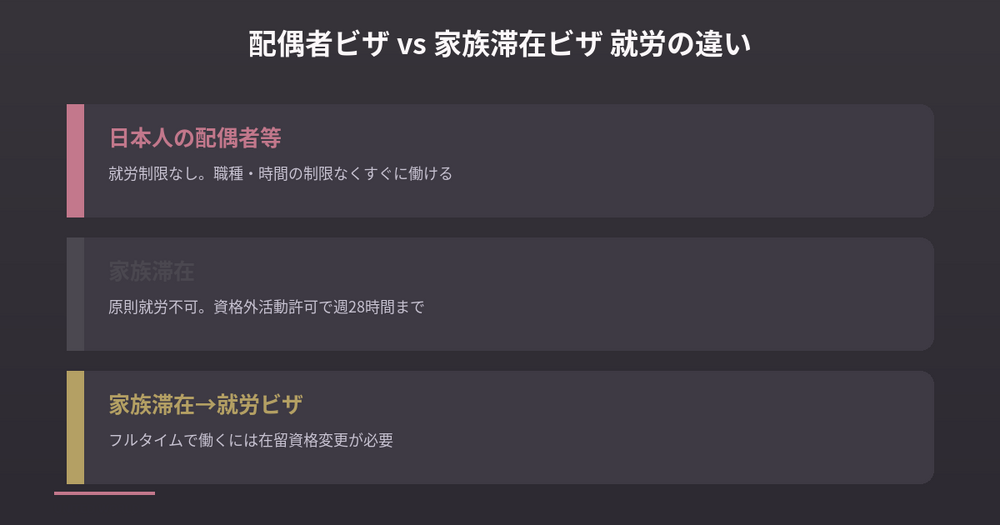
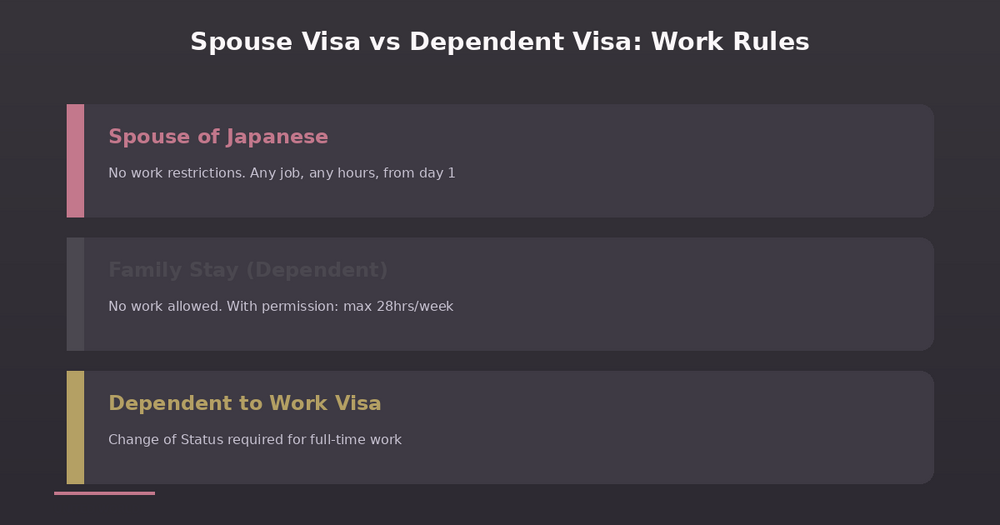
Spouse visa vs dependent visa: Work rules compared


Spouse of Japanese National Visa

No work restrictions whatsoever. You can work full-time from day one.
- Any job type (employee, part-time, freelance, business owner)
- No hour limits
- No additional work permission needed
- Residence Card states 'No work restriction'

Family Stay (Dependent) Visa

Work is not permitted in principle.
- With 'Permission to Engage in Activity Other Than That Permitted': max 28 hrs/week
- Prohibited industries (entertainment districts, etc.)
- Exceeding 28 hours is illegal - penalties for both worker and employer
- Full-time work requires Change of Status to a work visa

Spouse of Permanent Resident Visa

Same as spouse visa - no work restrictions. For spouses of foreign permanent residents.

How to change from dependent visa to work visa


Full-time work from a dependent visa requires a Change of Status application.
Target work visas

Engineer/Humanities/Intl ServicesMost common. IT, sales, accounting, translation. Requires degree or 10yr experience
Designated Activities 46JP university graduate + high Japanese (N1). Allows customer-facing and on-site work
Specified Skilled WorkerPass sector exam + N4+. No degree required

Required documents

Key documents:
- Change of Status application form
- Photo, passport, Residence Card
- Degree certificate + explanation of relevance to job duties
- Employment contract (duties and salary)
- Company registration, financials, company profile
- Fee: 6,000 yen (counter) / 5,500 yen (online)
- Review period: 1-3 months
Warning: If you have a history of working over 28 hours on a dependent visa, your change application is at high risk of rejection. Shift records, pay slips, and tax certificates will be checked.

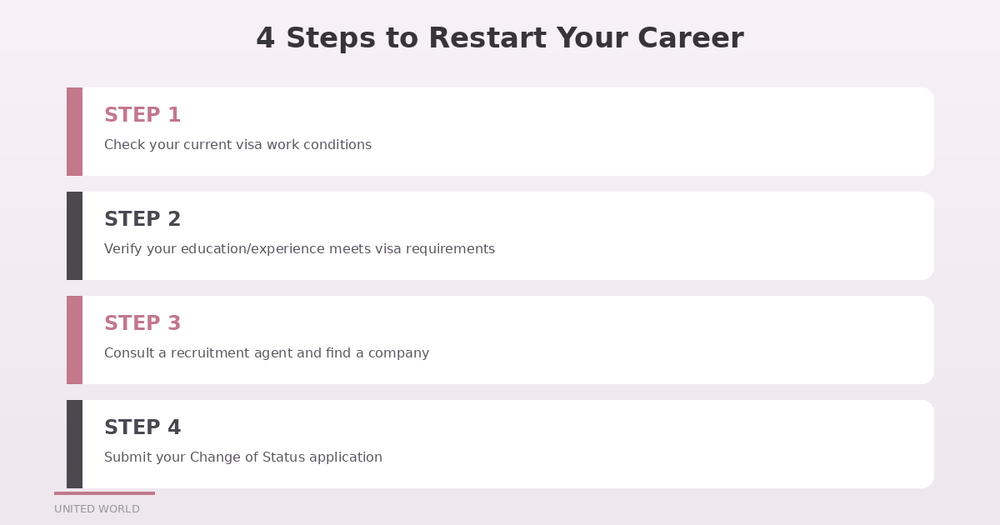
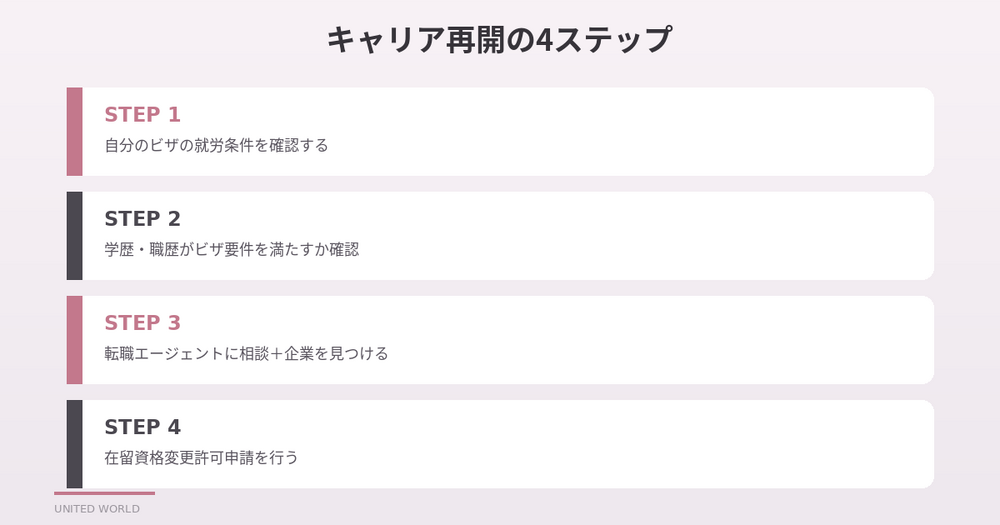
4 steps to restart your career


STEP 1: Check your visa work conditionsSpouse visa = work freely. Dependent visa = change required. Check the 'work restriction' field on your Residence Card
STEP 2: Verify education/experience meets requirementsFor Engineer/Humanities visa: degree or 10yr experience. Field must relate to the job
STEP 3: Consult a recruitment agentFind companies that support visa changes. Agents pre-check visa compatibility
STEP 4: Submit Change of Status applicationAfter signing employment contract. Cannot start new duties until approved (1-3 months)

Even with a long career gap, changing to a work visa is very achievable if you have the right qualifications. Do not give up - consult an agent first.

Important considerations for spouse visa holders


The spouse visa offers maximum work freedom, but there are considerations to keep in mind.

1. Visa stability depends on the marriage
If you divorce, the spouse visa cannot be maintained. You must change to another status (work visa, long-term resident, etc.) within 6 months. Obtaining PR or an independent work visa provides long-term security.
2. Faster path to PR
Spouses of Japanese nationals can apply for PR after 3 years of marriage + 1 year of residence. Much faster than the standard 10 years.
3. Build HSP points while on spouse visa
You can work on a spouse visa while accumulating HSP points for a PR application. No visa change needed to work, so career advancement and PR planning can happen simultaneously.

What happens in case of divorce or death of spouse


Divorce or death of your spouse directly affects your residence status.

Spouse of Japanese National visa:
- After divorce or bereavement, change to a new status within 6 months
- Options: work visa, long-term resident (depending on marriage duration and ties to Japan), or PR if already obtained
- 14-day notification to immigration is mandatory
Family Stay (Dependent) visa:
- After divorce from sponsor, change within 3 months (Immigration Act Article 22-4)
- Options: work visa, student visa, etc.
- If sponsor returns home, dependent visa becomes untenable

In either case, consult an immigration specialist or recruitment agent immediately to secure your residence status.

Summary: Understand your visa and take charge of your career


Spouse visaNo work restrictions. Work freely. Divorce requires visa change
Dependent visaNo work allowed. 28hrs/week with permission. Full-time needs status change
Career restart keySkills inventory + recruitment agent consultation
Long-term stabilityPR provides independence from marriage-based residence

Your career should not be limited by your visa type. With the right knowledge and support, you can maintain your family role while building a professional career in Japan.


We support career restarts for spouse and dependent visa holders

United World Inc. specializes in career support for foreign white-collar professionals.

United World support includes:
- Career consultation for spouse and dependent visa holders
- Visa change guidance when needed
- Job matching that leverages your skills despite career gaps
- Success-fee model - zero cost for job seekers

Contact United World Inc. here

Services for hiring companies


back to the list

TOP