Career Planning for Permanent Residency - Requirements, Screening Points, and the Fastest Route

2026.06.22

  • Career Advice
永住権を見据えたキャリア設計――取得条件・審査ポイントと最短ルート

If you plan to build a long-term career in Japan, permanent residency (PR) is the ultimate goal. No work restrictions, housing loans, freedom to start a business, no more visa renewals - PR maximizes your freedom in Japan.

But since 2026, PR screening has become significantly stricter. Tax and social insurance payment history is now scrutinized, and a PR revocation system takes effect in 2027.

This article covers the 3 routes to PR, the 4 key screening factors, and concrete preparation strategies to avoid rejection.
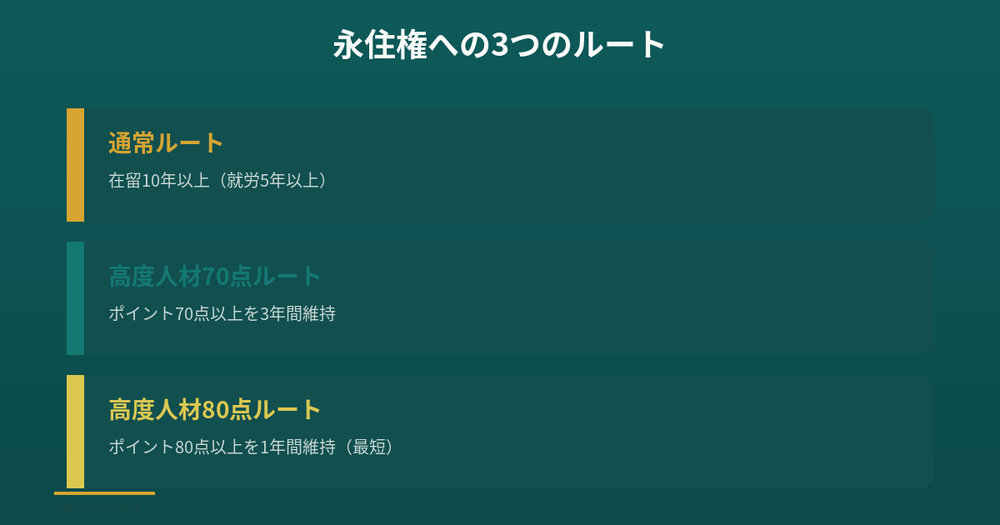
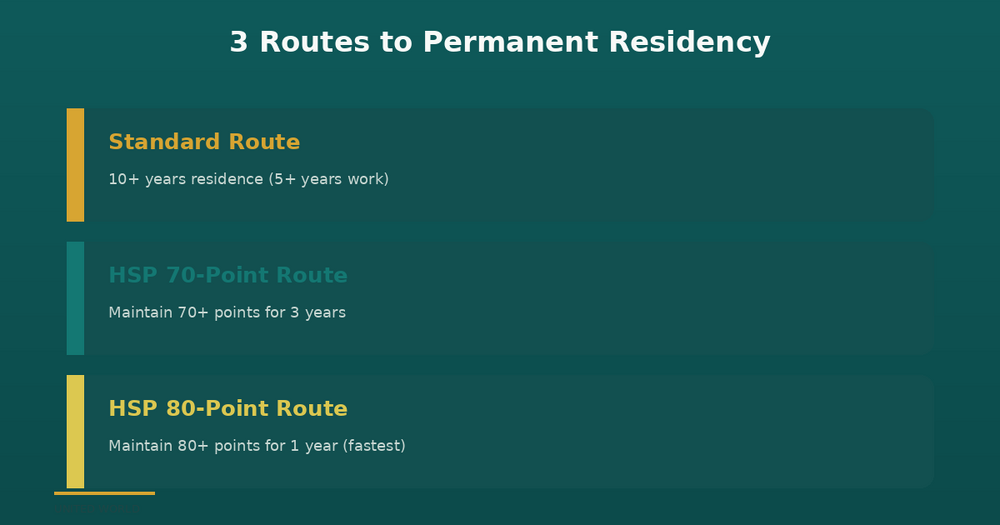
3 routes to permanent residency


Route 1: Standard (10 years)

Requirement: 10+ continuous years of residence, including 5+ years on a work visa.
- The most common path
- 'Continuous' means extended absences may break the count (150+ days/year abroad is risky)
- Reduced to 3 years if married to a Japanese national

Route 2: HSP 70-Point (3 years)

Requirement: Maintain 70+ HSP points continuously for 3 years.
- Works even on Engineer/Humanities visa (no need to switch to HSP visa)
- Points must be maintained for the entire 3 years - any dip below 70 disqualifies

Route 3: HSP 80-Point (1 year - fastest)

Requirement: Maintain 80+ HSP points continuously for 1 year.
- The fastest PR path: Japan's 'Green Card' for highly skilled professionals
- J-Skip (Masters + 20M yen income) bypasses points calculation entirely
- Works on Engineer/Humanities visa if points are met

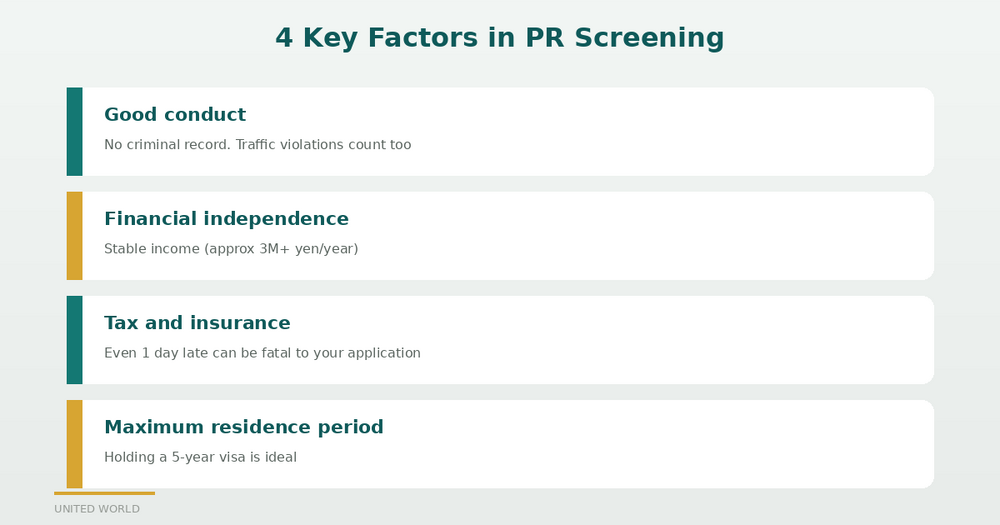
4 key factors in PR screening


Even with enough points and years, failing these 4 requirements means rejection.
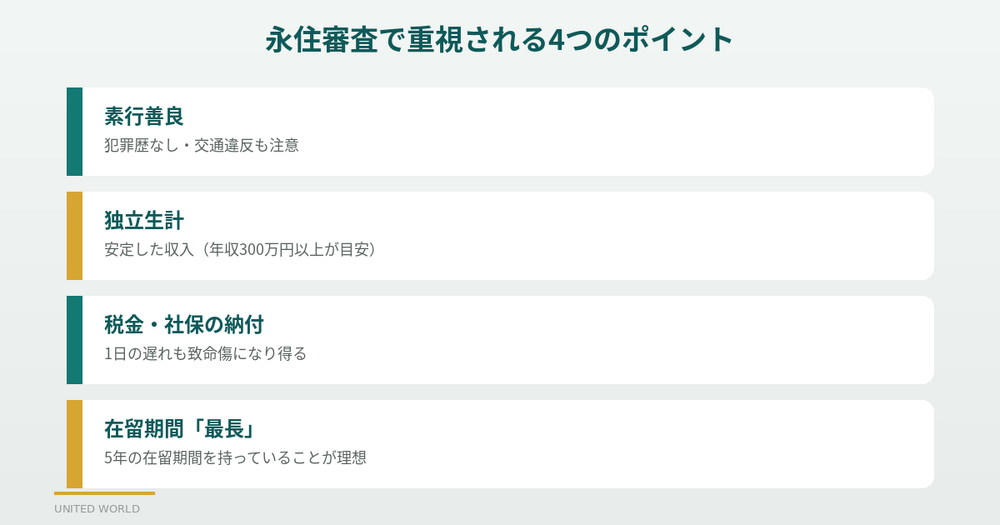
1. Good Conduct

No criminal record. Traffic violations (speeding, parking) also count. Multiple violations in 5 years increase rejection risk.

2. Financial Independence

Stable income is required. Guideline is 3M+ yen/year (higher with dependents). Both current and future earning potential are assessed.

3. Tax and Social Insurance Payments

This is the single biggest hurdle from 2026 onward.
- Residence tax, income tax, pension, and health insurance must ALL be paid on time
- Even 1 day late can be fatal to your application
- Payroll deduction (special collection) is safe. Self-payment requires extreme care
- Past 2-3 years of payment records are reviewed

4. Maximum Residence Period

Having a 3-year or 5-year visa is effectively required. 5-year is increasingly preferred under stricter screening.

Career strategies for PR


Strategy 1: Perfect tax and insurance payment from todayThe biggest PR pitfall. If you pay pension/health insurance yourself, ensure zero delays. Choose a company with payroll deduction if possible
Strategy 2: Boost HSP points for the fastest route80+ pts = PR in 1 year. Use salary negotiation, JLPT, Masters degree (see Article 14)
Strategy 3: Time job changes around PR applicationChanging jobs during PR review can affect the outcome. Stay stable during the process
Strategy 4: Avoid extended time abroad150+ days/year outside Japan risks breaking your continuous residence count

PR is not something you 'apply and hope for' - it is something you prepare for systematically.

2026 update: How PR tightening affects you


Tightening 1: Payment history scrutinized
Past payment delays are now reviewed even if cleared before application. Previously, catching up 2 years was enough. Going forward, the history itself may be grounds for rejection.
Tightening 2: PR revocation system (2027)
Deliberate non-payment of taxes or insurance after obtaining PR can lead to revocation. 'Once obtained, always safe' is no longer true.
Tightening 3: MyNumber data sharing
From 2026+, municipalities, tax authorities, and immigration will share payment data via MyNumber. Non-payment will be automatically flagged.
Tightening 4: Residence period requirements
5-year visa is increasingly expected. Previously 3 years was treated as 'maximum' but this is tightening.

PR vs Naturalization: Which should you choose


PR and naturalization (Japanese citizenship) are different paths.

Permanent ResidencyKeep your original nationality. Option to return home stays open. No voting rights. Residence Card renewal every 7 years
NaturalizationGain Japanese citizenship. Full voting rights. Japanese passport (top-tier travel freedom). But most countries do not allow dual nationality - original citizenship is lost

If you want to keep the option of returning home: PR. If you plan to settle permanently: consider naturalization. Both require clean tax/insurance records and stable residence.

Summary: PR requires reverse-planning from day one


Standard route10 years residence (5 years work)
70-point route3 years with 70+ HSP points
80-point route1 year with 80+ HSP points (fastest)
Critical factorPerfect tax and insurance payment. Zero tolerance for delays

PR is only achievable by those who prepare systematically. Do not wait for 'someday.' Start planning backwards from today - design both your career and your daily finances around this goal.


Let us help you plan your PR strategy

United World Inc. specializes in career support for foreign white-collar professionals.

United World support includes:
- Long-term career strategy with PR in mind
- HSP points calculation support
- Introductions to companies with payroll tax deduction
- Success-fee model - zero cost for job seekers

Contact United World Inc. here

Services for hiring companies


back to the list

TOP