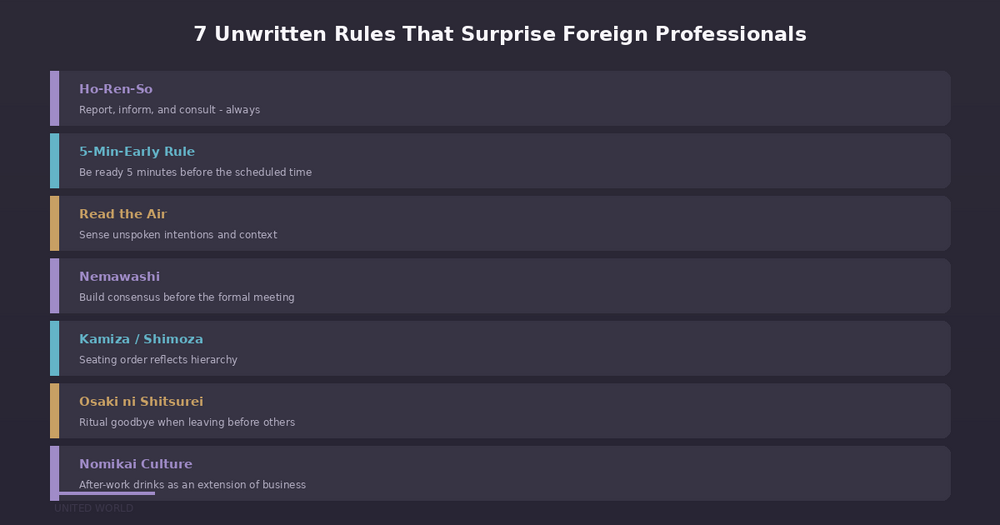
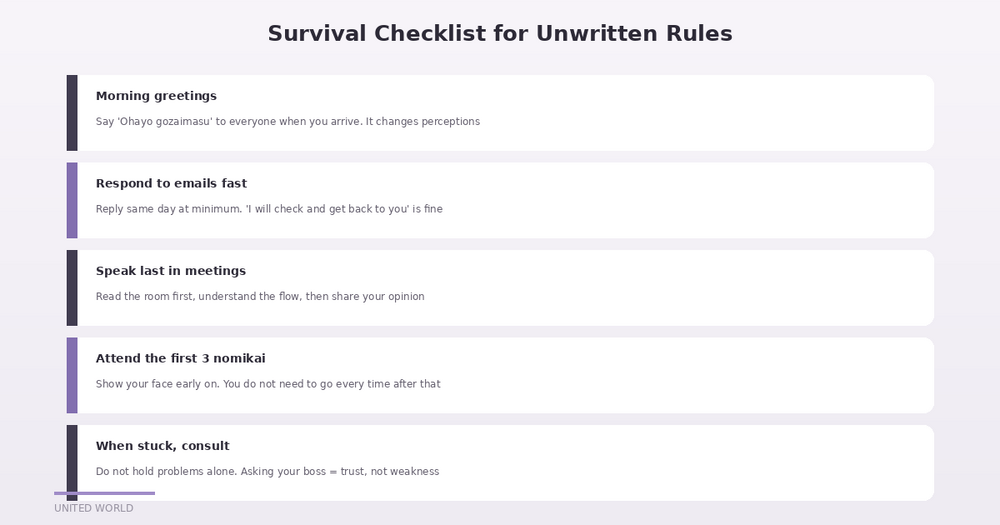
Japanese workplaces are governed by countless unwritten rules that never appear in any employee handbook. Ho-Ren-So, nemawashi, reading the air, the 5-minute-early rule, seating hierarchy - these are second nature to Japanese employees but invisible barriers for foreign professionals.
Not knowing them risks being labeled as lacking teamwork or common sense. But understanding and practicing these rules can earn you more trust than even Japanese colleagues. This article systematically breaks down the most common unwritten rules with explanations of why they exist and how to navigate them.
コミュニケーションの暗黙のルールCommunication: The unwritten rules
Ho-Ren-So is called the 'lifeblood' of Japanese organizations.
Why it matters: Japanese companies operate as teams. Acting on individual judgment without sharing is seen as 'going rogue.' Process-sharing builds trust.
Common mistake: Focusing only on results and not sharing progress. This leads managers to feel 'I have no idea what they are doing.'
How to adapt: Report not just outcomes but progress. When stuck, consult your manager. In Japan, consulting is a sign of trust, not weakness.
Reading the Air (Kuuki wo Yomu)
'Hai' (Yes) does not always mean agreement.
Why: Japan is a high-context culture. You are expected to read between the lines. Direct rejection is avoided.
Examples: 'Chotto muzukashii desu ne' (That is a bit difficult) = Almost certainly 'No' 'Kentou shimasu' (We will consider it) = Usually means 'We will not do it'
How to adapt: Do not take words at face value. Watch facial expressions, tone, and follow-up actions. If unsure, ask privately later.
Nemawashi (Pre-meeting Consensus)
Building agreement BEFORE the formal meeting.
Why: In Japanese companies, meetings are for 'confirmation,' not 'decision.' Getting key stakeholders on board beforehand ensures smooth proceedings.
How to adapt: Before proposing anything significant, speak individually with your manager and relevant department heads.
時間と行動の暗黙のルールTime and behavior: The unwritten rules
Not all Japanese companies enforce unwritten rules equally.
Companies with relaxed rules: - Foreign-affiliated companies (global standards) - IT startups (flat culture) - Japanese firms adopting job-based systems (Fujitsu, Hitachi, etc.) - Workplaces with many foreign employees
Companies with strict rules: - Traditional Japanese corporates (manufacturing, finance, trading companies) - Government organizations - Regional SMEs - Service and hospitality industry
Ask your recruitment agent for 'companies with a relaxed or international culture' and they can match you accordingly.
まとめ:暗黙のルールは「敵」ではなく「味方」になるSummary: The unwritten rules can become your greatest ally
Read the AirLook beyond words. Confirm privately if unsure
NemawashiBuild consensus before the meeting
5-Min-EarlyOn time = late. Build in margin
Seating HierarchyWhen in doubt, ask
NomikaiAttend the first few. Not required every time
Understanding and practicing unwritten rules is the fastest path to becoming a trusted foreign professional in Japan. You do not need to be perfect. Simply showing the effort makes all the difference.
Want guidance from someone who knows Japanese work culture inside out?
United World Inc. specializes in career support for foreign white-collar professionals.
United World support includes: - Career advisors fluent in Japanese workplace culture - Listings at companies with relaxed and international cultures - Interview coaching covering Japanese business etiquette - Success-fee model - zero cost for job seekers
LinkedIn・履歴書・職務経歴書はどれも任意です。1つでもご提出いただくと、よりスムーズに求人をご紹介できます。LinkedIn, resume and CV are all optional. Sharing any one of them helps us introduce jobs faster.