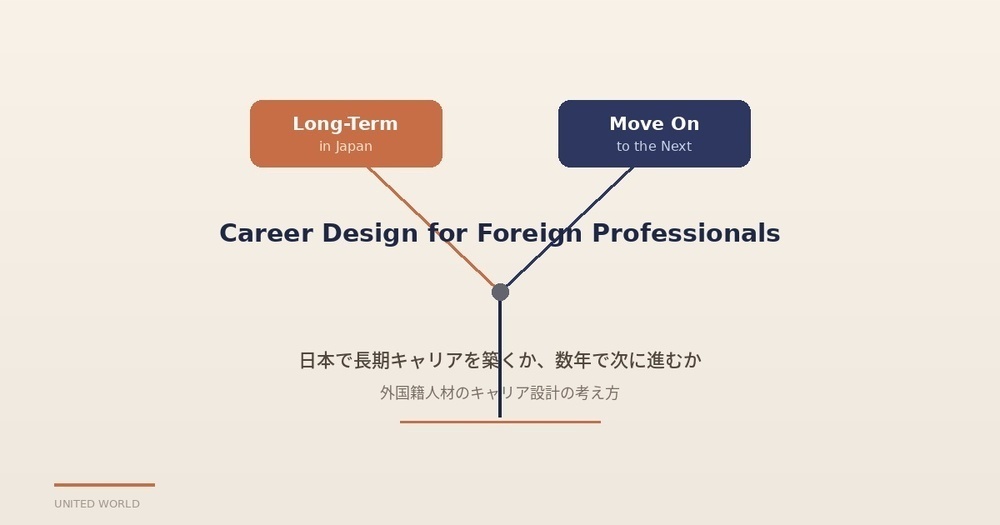
Every foreign professional in Japan faces this question: Should I build a long-term career here, or gain a few years of experience and move on?
There is no universal right answer. But delaying the decision is itself a risk. Staying long-term requires pursuing permanent residency and management experience. Moving on requires strategically building transferable skills. This article compares the pros and cons of each path and provides a framework for making the right choice.
長期キャリア(5年以上)のメリットとデメリットLong-term career (5+ years): pros and cons
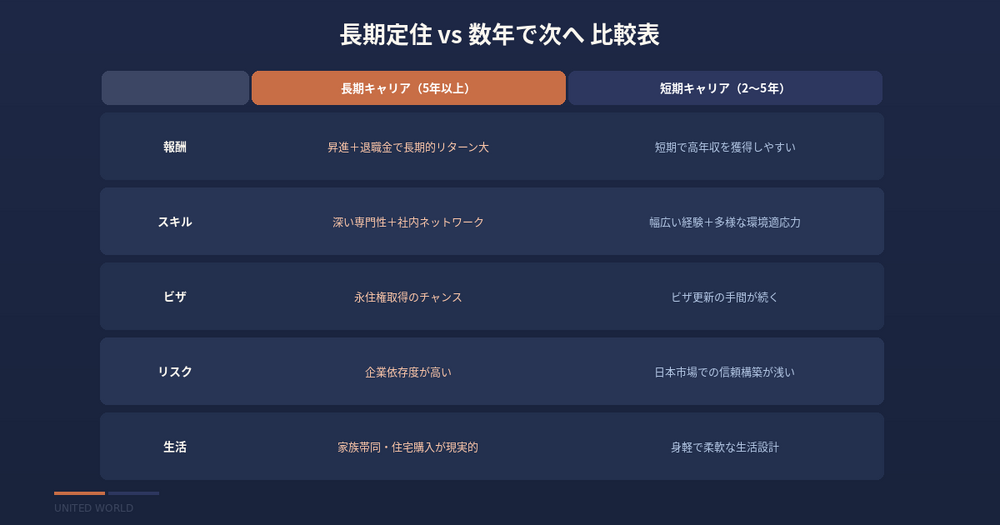
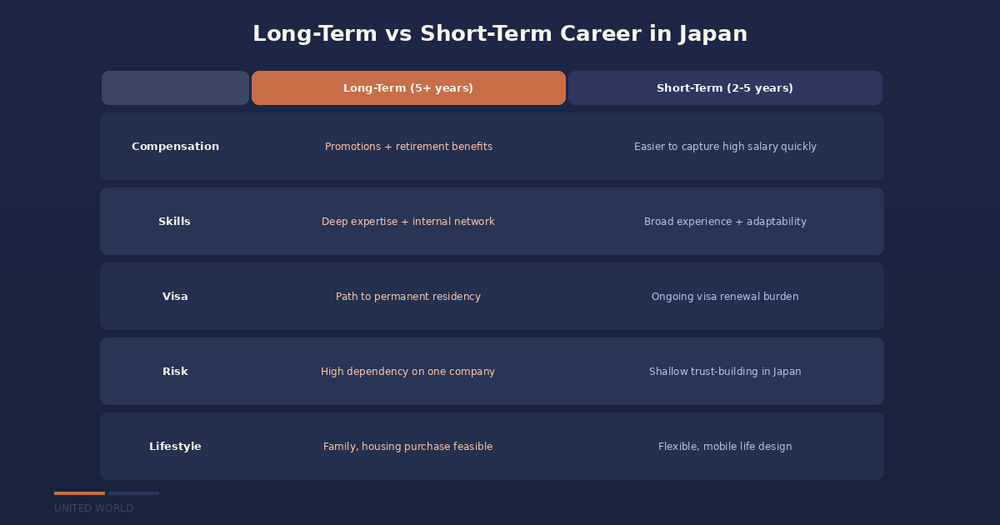
1. Permanent residency becomes achievable 10 years of residence (5 years of work) qualifies you for PR. With 80+ points on the Highly Skilled Professional scale, you can apply in just 1 year.
2. Management promotion track Japanese companies value tenure. 5+ years opens the door to management candidacy.
3. Deep expertise and network Long tenure builds irreplaceable specialization and relationships.
4. Retirement benefits Japanese company retirement pay is proportional to years of service. 10+ years yields significant returns.
Disadvantages
High company dependency: Staying too long at one firm can make your market value hard to assess. Career rigidity risk: Japan-specific skill sets may reduce competitiveness in global markets. Reduced adaptability: Long tenure in one environment can dull sensitivity to new trends.
短期キャリア(2~5年)のメリットとデメリットShort-term career (2 to 5 years): pros and cons
1. Maintain high market value Multi-company, multi-country experience is highly valued in global talent markets. Especially in IT and consulting, diverse experience is a competitive edge.
2. Frequent salary negotiation opportunities Each job change is a chance to negotiate higher compensation.
3. Flexible career design Build a global career path: Japan, Singapore, Europe - no country lock-in.
4. Broad skill set Exposure to different cultures, tech stacks, and business models builds adaptability.
Disadvantages
Permanent residency becomes difficult: Hard to meet the 10-year continuous residence requirement. Shallow trust in Japanese companies: Multiple job changes can be viewed negatively (see Article 8). No retirement benefits: Short tenure means virtually zero retirement pay.
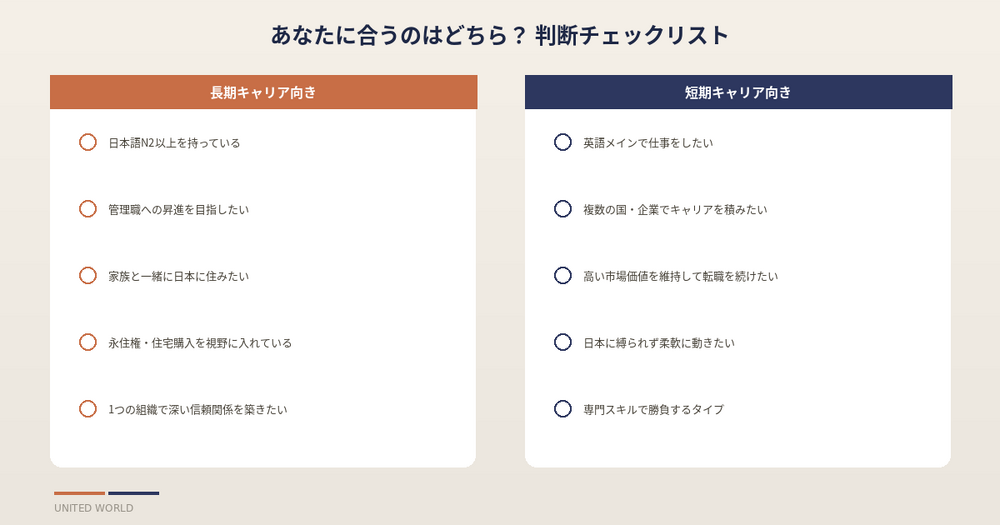
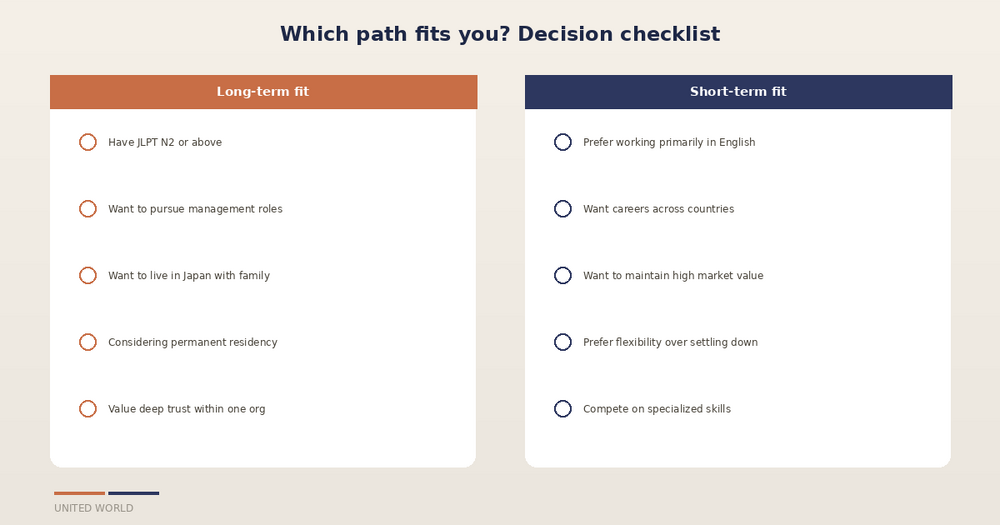
判断基準:何を軸に決めるかDecision framework: What should guide your choice
The worst strategy is drifting without a plan. Whether you choose long or short, clarity on 'Where do I want to be in X years?' is the foundation of good career design.
【2026年最新】永住権の厳格化が長期キャリアに与える影響2026 update: How PR tightening affects long-term planning
If you choose the long-term path, permanent residency policy changes cannot be ignored.
2026 tightening highlights: - PR screening is stricter. Social insurance and tax payment history are now scrutinized - From 2027, a PR revocation system takes effect. Deliberate non-payment = loss of PR - MyNumber-linked payment data sharing begins 2026+ - 'Maximum residence period' requirement enforcement is tightening
If you choose long-term: - Pay social insurance and taxes on time without exception - Calculate your Highly Skilled Professional points (70+ = 3 years to PR, 80+ = 1 year) - Consult an immigration lawyer before applying - Consider naturalization as an alternative (note: loss of original nationality)
第3の選択肢:ハイブリッド型キャリアThe third option: Hybrid career design
In reality, it does not have to be a binary choice. A hybrid approach captures the best of both worlds.
Hybrid examples: - 5 years in Japan, get PR, then take an overseas role, return to Japan later - Stay at a Japanese company but do overseas assignments - Build expertise in Japan, then take a remote role for an overseas firm - Freelance with both Japanese and international clients
With permanent residency, Japan becomes your 'home base' from which you can pursue global opportunities with maximum freedom. The strategy of 'settle for 5 years, get PR, then go global' is highly rational for many foreign professionals.
まとめ:キャリア設計は「今」始めるSummary: Start designing your career today
Long-termPR, management track, retirement pay. For those who value stability and depth
Short-termHigh salary, global experience, flexibility. For those who value mobility
HybridGet PR first, then go global. Japan as home base
Decision axesFamily, Japanese ability, skill type, PR interest, risk tolerance
The most important thing in career design is not to postpone the decision. Whether long or short, those who move with a strategy end up with the best careers.
Let us help you design your career
United World Inc. specializes in career support for foreign white-collar professionals.
United World support includes: - Both long-term and short-term career opportunities - PR and visa strategy advice - Highly Skilled Professional points calculation - Success-fee model - zero cost for job seekers
LinkedIn・履歴書・職務経歴書はどれも任意です。1つでもご提出いただくと、よりスムーズに求人をご紹介できます。LinkedIn, resume and CV are all optional. Sharing any one of them helps us introduce jobs faster.