Will having too many job changes hurt me in Japan? This is one of the most confusing aspects of the Japanese job market for foreign professionals.
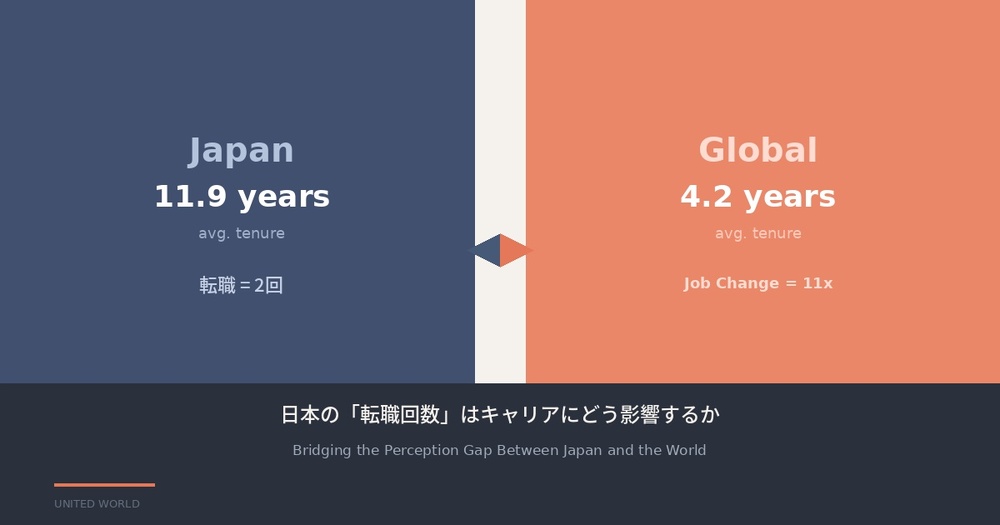
Globally, changing jobs is seen as a sign of career growth. In Japan, it can still carry a stigma. The US average is 11.7 lifetime job changes with 4.2-year tenure. Japan averages 11.9-year tenure with a 7.6% turnover rate in 2025 - the numbers make the gap crystal clear.
This article explains how job change frequency really affects your career in Japan, and how foreign professionals with multiple changes can still win.
日本と海外の「転職回数」に対する認識ギャップThe perception gap between Japan and the world
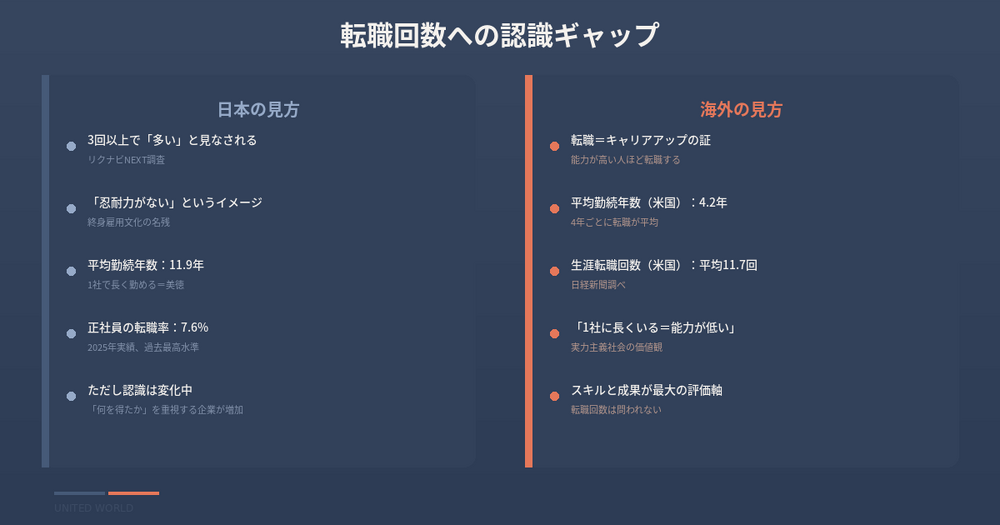
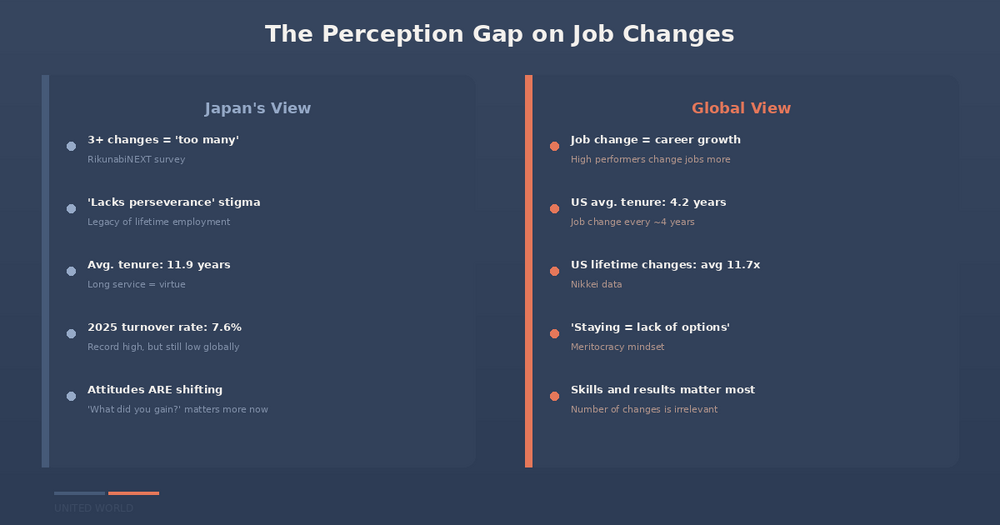
In Western countries, changing jobs is seen as evidence of proactive career design. High performers change jobs because they are in demand. Staying at one company too long can even be viewed negatively - as lacking the ability to move. Skills and results are the primary evaluation criteria, not the number of companies on your resume.
The Japanese reality: still some stigma
In Japan, 3 or more job changes is generally considered 'too many'. Common concerns include: Does this person lack perseverance? Is there no consistency in their career plan? The legacy of lifetime employment culture means long tenure is still seen as a virtue by many hiring managers.
But attitudes ARE shifting
Critically, Japanese attitudes are evolving. The 2025 turnover rate of 7.6% is a record high. More companies now ask 'what did you gain?' rather than 'why did you leave?' Job-based employment systems are spreading, and skill-based evaluation is becoming the norm - especially in IT and tech.
年代別・業界別:転職回数の「許容ライン」はどこかTolerance thresholds by age and industry
40s+4-5: acceptable / judged flexibly if experience matches
Industry differences
Industries tolerant of multiple changes: - IT and tech (high mobility; 3-5 companies is normal) - Foreign-affiliated companies (evaluated by global standards) - Consulting (project-based work culture) - Startups (skills-first, diversity of experience welcomed)
Industries cautious about job changes: - Japanese manufacturers (long tenure culture is strong) - Finance and insurance (stability-oriented) - Regional SMEs (retention is the top priority)
Good news for foreign professionals: in gaishikei and IT, overseas job changes are almost never viewed negatively. Your diverse experience is valued as that of a ready-made contributor.
転職回数が多い場合の具体的な対策Concrete strategies when you have many job changes
You cannot change your number of job changes. But you CAN change how they are presented.
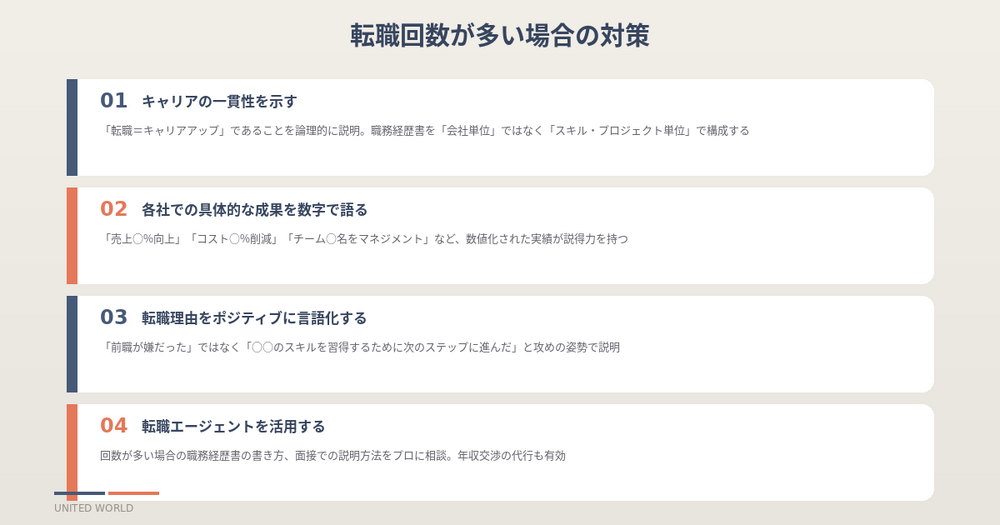
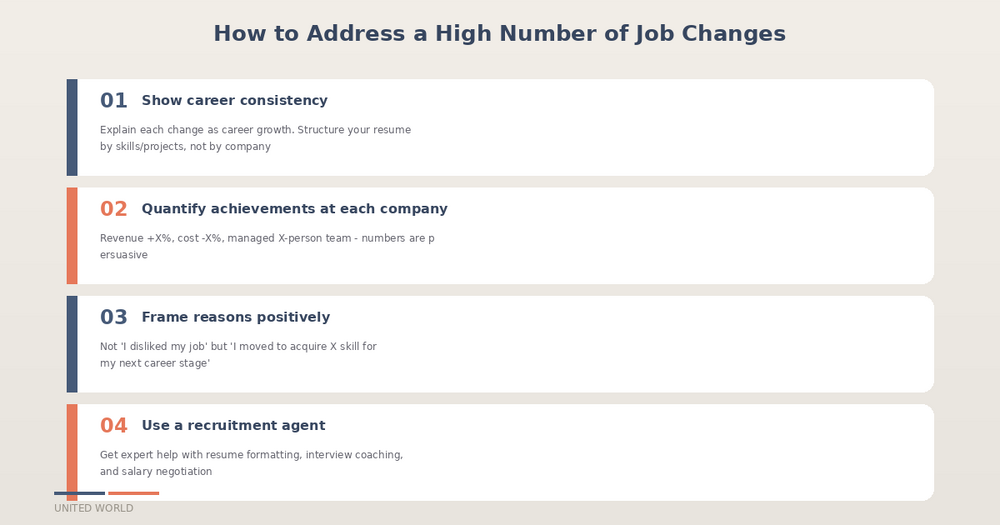
Strategy 1: Show career consistency
Structure your resume by skills and projects, not by company. Show a growth story: 'Frontend dev at 3 companies, then full-stack at 2, now a tech lead.' The reader should see a clear career arc, not a list of company names.
Strategy 2: Quantify achievements at each company
'Revenue +X%,' 'Cost -X%,' 'Managed X-person team' - numbers override concerns about job change frequency. If you delivered results everywhere, the count becomes irrelevant.
Strategy 3: Frame every reason positively
For the inevitable 'Why did you leave?' question, answer with: 'I moved to acquire X skill for my next career stage' or 'I sought a role with greater impact.'. Never say 'I did not like my previous job.'
Strategy 4: Use a recruitment agent
Professionals with multiple changes benefit most from expert support. An agent can restructure your resume to emphasize consistency, coach your interview answers, connect you with companies that value skills over tenure, and negotiate salary on your behalf.
外国籍人材が知っておくべき追加の注意点Additional considerations for foreign professionals
Foreign professionals face additional factors that Japanese candidates do not.
Visa implications Excessively frequent job changes may affect visa renewal. Immigration may scrutinize 'employment stability' if you have multiple changes under one year each.
The 3-month rule If you resign while on a work visa, failing to find a new job within 3 months can lead to visa revocation. Always secure your next role before resigning.
Explaining overseas experience Preface your career story with 'In my home country, job changes for career growth are standard practice'. Japanese interviewers understand cultural differences. What matters most is convincing them you intend to stay long-term in Japan.
Ultimately, what Japanese hiring managers care about most is not the number itself, but these three things:
1. Career consistencyIs there a 'story' behind your changes? Does your career path show intentional growth?
2. Results at each companyDid you deliver measurable impact everywhere? Can you prove it with numbers?
3. Commitment to THIS companyCan you dispel the concern that you will leave again? Can you articulate your vision for staying?
Having multiple job changes is no longer a dealbreaker in 2026 Japan. What matters is giving those changes meaning and weaving them into a compelling career narrative.
まとめ:転職回数は「過去」、あなたの価値は「今」で決まるSummary: Your past is the count, your value is the present
You cannot change your job change count, but you CAN change how it is perceived. And Japan's job market is evolving faster than you might think.
Concerned about your job change history?
United World Inc. specializes in career support for foreign white-collar professionals.
United World support includes: - Resume optimization for multiple job changes (emphasizing skill consistency) - Access to gaishikei and job-based companies that value skills over tenure - Interview coaching (how to explain your career story) - Salary negotiation - Success-fee model - zero cost for job seekers
LinkedIn・履歴書・職務経歴書はどれも任意です。1つでもご提出いただくと、よりスムーズに求人をご紹介できます。LinkedIn, resume and CV are all optional. Sharing any one of them helps us introduce jobs faster.