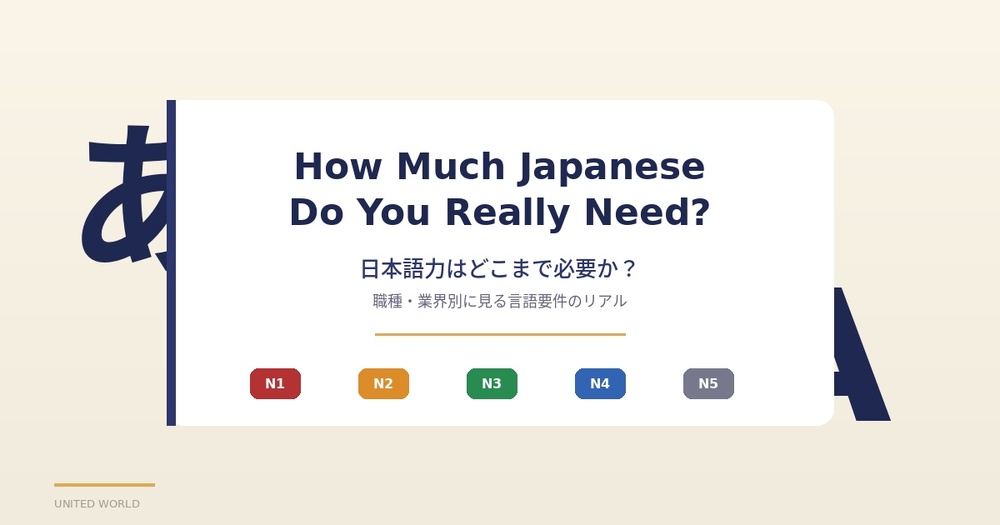
How Much Japanese Do You Really Need? Language Requirements by Role and Industry

2026.06.18

  • Career Advice
日本語力はどこまで必要か? 職種・業界別に見る言語要件のリアル

Can I work in Japan without speaking Japanese? This is the most common question foreign professionals ask when considering employment in Japan.

The short answer: yes, there are roles and companies where Japanese is not required. But it is equally true that the majority of positions in Japan do require some level of Japanese.

Adding urgency, from April 15, 2026, the Engineer/Humanities/International Services visa now requires JLPT N2-equivalent proof for client-facing roles - a significant regulatory change.

This article provides a realistic breakdown of Japanese language requirements by role and industry, plus what the 2026 regulation change means for you.

JLPT quick guide: What each level means in practice


JLPT (Japanese Language Proficiency Test) is the most widely used measure of Japanese ability. Here is what each level means in practical terms:

N1 (CEFR C1)Business advanced. Can handle complex professional discussions
N2 (CEFR B2)Business intermediate. Can manage most daily work tasks
N3 (CEFR B1)Conversational. Can handle simple workplace interactions
N4 (CEFR A2)Basic. Can manage daily life but not work tasks
N5 (CEFR A1)Beginner. Greetings and simple words only

Key point: JLPT only tests reading and listening - not speaking or writing. Someone with N2 may struggle with conversation, while an N3 holder might speak fluently. Companies evaluate both JLPT scores and actual conversational ability in interviews.

By role: What Japanese level is actually needed


Roles where Japanese is largely unnecessary

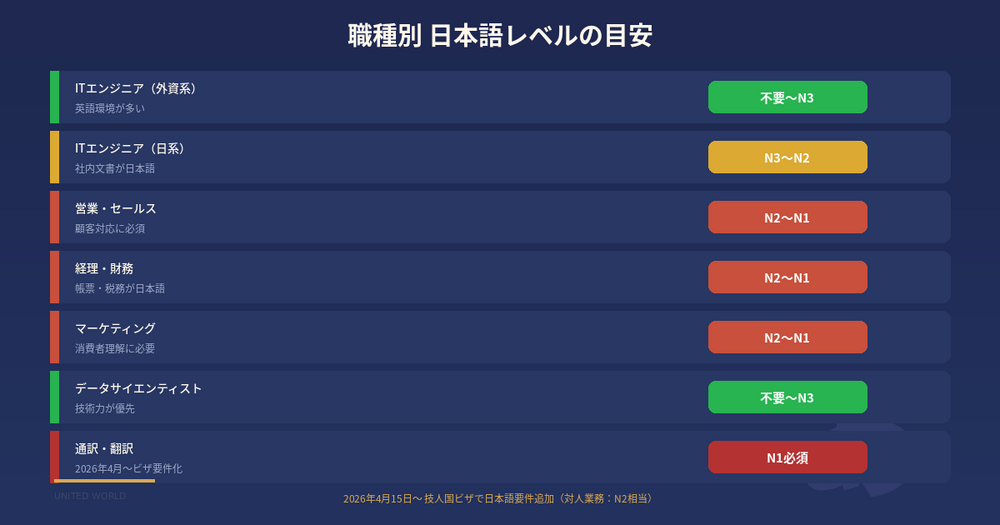
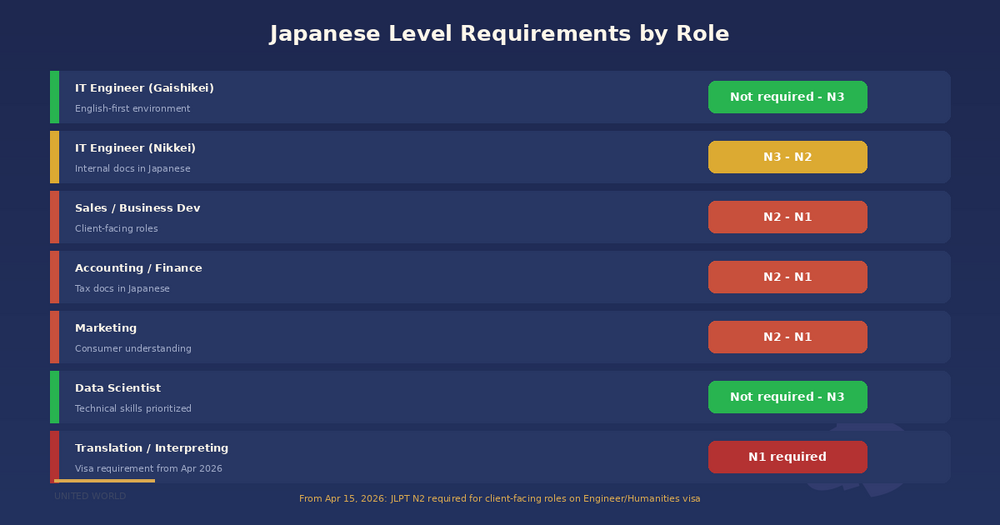
IT Engineer (Foreign-affiliated tech)
- English is the working language at many firms (Google, Amazon, Microsoft, etc.)
- Technical skills are prioritized over Japanese ability
- Code reviews and technical documentation are in English
- Required level: Not required to N3
Data Scientist / AI Engineer
- High specialization means skills outweigh language
- Reporting in English is standard at many firms
- Required level: Not required to N3

Roles where N2+ is expected

Sales / Business Development / Marketing
- Direct interaction with Japanese clients requires N2 to N1
- Email, phone calls, presentations in Japanese
- Keigo (honorific language) usage is expected
Translation / Interpreting / Customer-facing roles
- N1 is essential. From April 15, 2026, N2-equivalent proof is required for visa applications
- The 2026 regulation change has the biggest impact on these roles

Roles where it depends on the company

Accounting / Legal / HR
- At Japanese companies: N2 to N1 is effectively required (financial documents, contracts, internal rules all in Japanese)
- At foreign-affiliated firms: N3 to N2 may suffice
- Reporting to global HQ is typically in English

By industry: Where can you work in English only


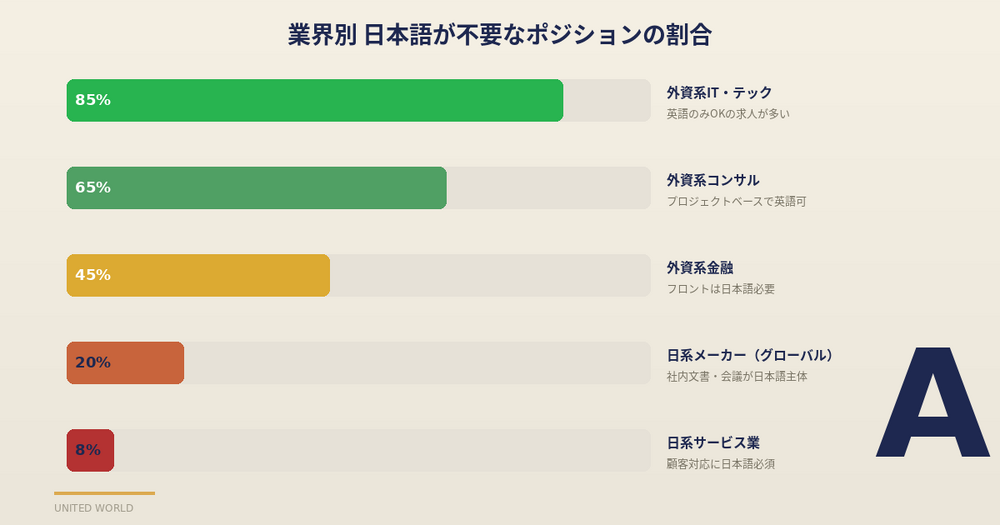
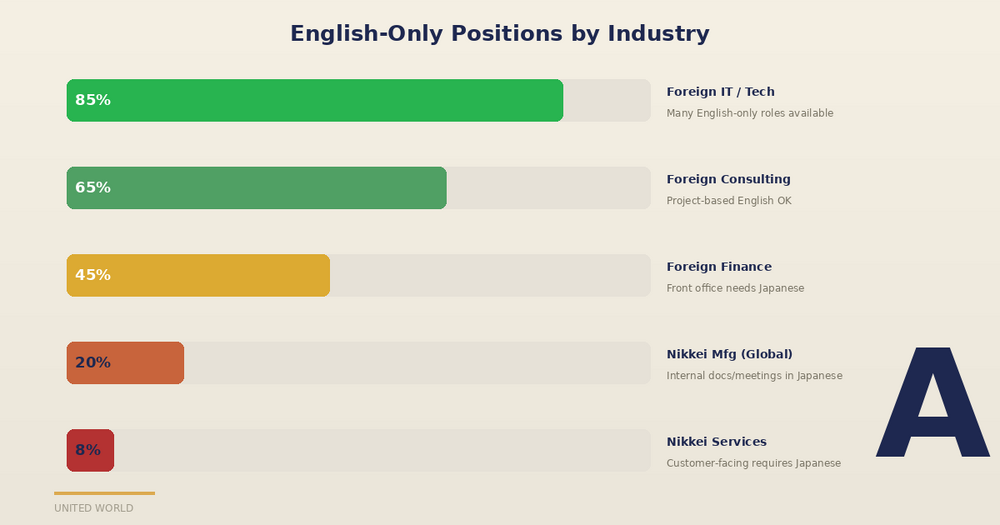
Even for the same role, Japanese requirements vary dramatically by industry.

Industries with many English-only positions:
- Foreign IT and tech companies (Google, AWS, Salesforce, etc.)
- Foreign consulting firms (project-based English OK)
- Foreign pharma and healthcare (R&D divisions often English-first)
- Startups (global teams, English culture)
Industries where Japanese is almost always required:
- Japanese manufacturers (internal documents, meetings, ho-ren-so in Japanese)
- Japanese service industry (customer-facing requires Japanese)
- Regional SMEs (often lack English infrastructure)
- Government and municipal organizations

Warning: Even when a job listing says English OK, the reality may require Japanese. Ask specifically in interviews: What language are internal meetings conducted in? Are emails in English or Japanese?

2026 Update: New Japanese language requirement for Engineer/Humanities visa


From April 15, 2026, the Engineer/Humanities/International Services visa (Gi-Jin-Koku) added a Japanese language requirement - a significant change for foreign professionals.

What changed:
- For client-facing roles (translation, interpreting, customer service, etc.), proof of CEFR B2-level Japanese (JLPT N2 or equivalent) must be submitted with visa applications
- Applies to COE (new entry), change of status, and renewal applications
- Graduates of Japanese universities or vocational schools are exempt
- Category 1 and 2 companies (listed companies, etc.) are exempt from document submission
Who is NOT affected:
- Engineers whose primary duties are technical (not client-facing)
- Graduates of Japanese educational institutions
- Those at Category 1/2 (major) companies
- Those renewing with the same job duties as before

This change does not exclude non-Japanese speakers from Japan. It clarifies the level needed for client-facing roles. Technical professionals such as engineers and data scientists are generally not affected.

Strategies for professionals with limited Japanese


Even without strong Japanese, there are clear paths to working in Japan.

Strategy 1: Target English-first companies
- Foreign tech firms and global startups are your best bet
- Search LinkedIn for 'English' and 'No Japanese required' positions
- Ask your recruitment agent to filter for English-only roles
Strategy 2: Differentiate through technical expertise
- Cutting-edge skills in AI, cloud, or security reduce the importance of Japanese
- Let your GitHub profile and portfolio speak for you
- If you ace the technical interview, the language barrier becomes secondary
Strategy 3: Build Japanese skills after joining
- Many companies offer Japanese training programs for new foreign hires
- AI tools (translation apps, ChatGPT) can bridge gaps in daily work
- Immersion in a Japanese environment is the fastest way to build practical skills

The key is: do not let Japanese ability alone narrow your possibilities.

Summary: Japanese ability is not everything


IT Engineer (Gaishikei)Not required to N3
Data ScientistNot required to N3
Sales / MarketingN2 to N1
Accounting / Legal / HRN2 to N1 (N3 at gaishikei)
Translation / Customer-facingN1 required (visa requirement from 2026)

Your market value is not defined by Japanese ability alone. Technical skills, management experience, and a global perspective are valued equally - or even more highly.

Not sure what positions match your Japanese level? A recruitment agent who knows the Japan market can map your skills to the right opportunities instantly.

Let us find roles that match your language level

United World Inc. specializes in career support for foreign white-collar professionals.

United World support includes:
- Extensive English-friendly job listings, including Japanese-not-required roles
- Matching based on your actual Japanese ability
- Interview coaching, salary negotiation, and visa support
- Guidance on the 2026 Japanese language requirement change
- Success-fee model - zero cost for job seekers

Contact United World Inc. here

Services for hiring companies


back to the list

TOP