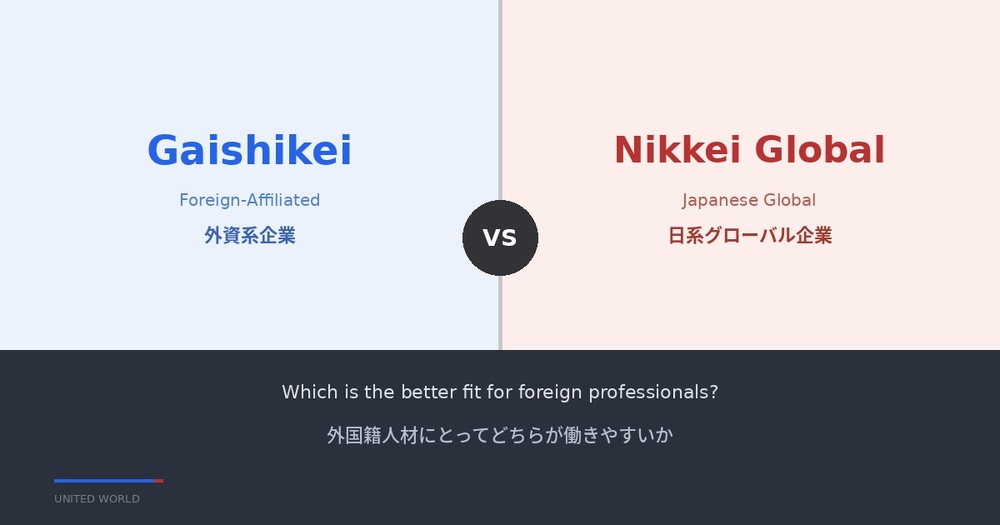
The first decision facing foreign professionals looking to change jobs in Japan is: "Should I target a foreign-affiliated (gaishikei) company or a Japanese global (nikkei global) company?"
"Gaishikei pays more." "Nikkei is more stable." These generalizations are widely known, but from a foreign professional perspective, the factors that truly matter go beyond salary and stability. What is the working language? How many foreign employees are there? How fast are decisions made? Does seniority affect promotions? These are the factors that determine your day-to-day experience.
This article compares gaishikei and nikkei global companies across four dimensions: evaluation, compensation, culture, and career path to help you decide which is right for you.
外資系企業と日系グローバル企業の基本的な違いThe fundamental differences between gaishikei and nikkei global companies
First, let us define each type and outline their core characteristics.
Foreign-Affiliated (Gaishikei): ・HQ or parent company is overseas (Google, Amazon, P&G, McKinsey, etc.) ・Management policies and evaluation systems are designed by global HQ ・Performance-based compensation ・English is often the primary working language ・Autonomy of the Japan office varies significantly by company
Japanese Global (Nikkei Global): ・HQ in Japan with active overseas expansion (Toyota, Sony, Hitachi, Rakuten, etc.) ・Japanese employment practices at the core, with globalization efforts underway ・Hybrid of seniority + performance-based evaluation ・Japanese is the primary language (some departments use English) ・Shift toward job-based (jobu-gata) HR systems is accelerating
The key point: "gaishikei = always better" and "nikkei = always outdated" are both oversimplifications. Some gaishikei run their Japan offices in a very Japanese way. Some nikkei, like Rakuten, have made English the official company language. What matters is looking at each company individually.
報酬・評価制度の比較Compensation and evaluation comparison
外資系の報酬・評価
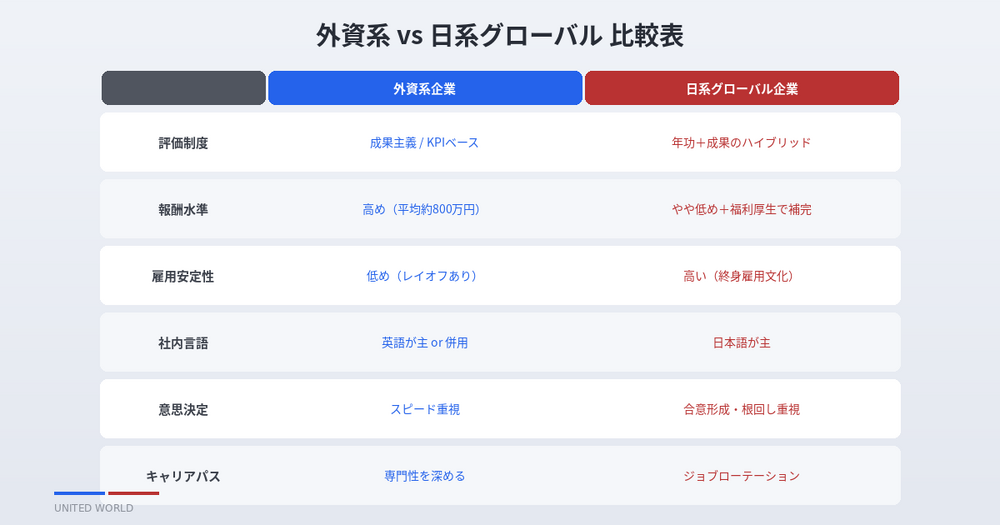
特徴: ・年収水準は日系の約1.5〜2倍(外資系平均約800万円 vs 日系平均約460万円) ・成果主義。個人のKPI達成度で評価 ・インセンティブ / RSU(株式報酬)が含まれるケースが多い ・退職金制度がない企業が多い(その分ベース給に上乗せ) ・年齢・勤続年数は報酬に影響しない
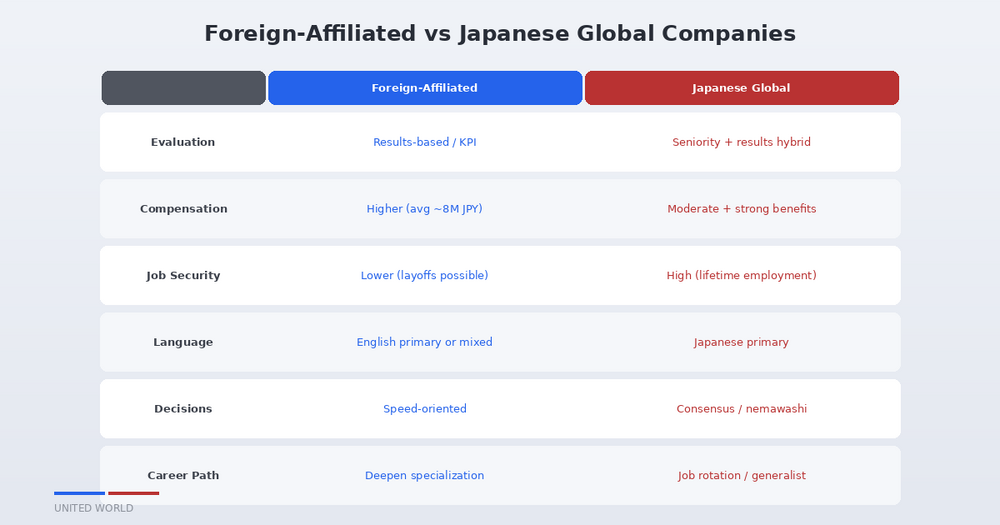
Key features: ・Salary levels are roughly 1.5 to 2x higher than nikkei (gaishikei avg ~8M JPY vs nikkei avg ~4.6M JPY) ・Performance-based. Individual KPI achievement drives evaluation ・Incentives / RSU (stock compensation) are often part of the package ・Retirement benefits are often absent (offset by higher base salary) ・Age and tenure do not affect compensation
Nikkei global compensation and evaluation
Key features: ・Salary is lower than gaishikei, but benefits (housing, family allowance, retirement, company housing) boost total compensation ・Seniority elements remain at many firms (though changing with job-based transition) ・Bonus is typically paid twice yearly, totaling 2 to 6 months ・Team-based evaluation is emphasized ・Incentives are designed for long-term retention
What this means for foreign professionals
Gaishikei = "high salary x results-based x individual evaluation." Best for those who want their skills fairly rewarded now. Nikkei global = "stability x team evaluation x comprehensive benefits." If you plan to settle in Japan long-term, the depth of benefits becomes a significant advantage.
Remember: gaishikei high salaries often come with "no retirement benefit" and "layoff risk." Always compare Total Compensation, not just base salary.
働き方・企業文化の比較Work style and corporate culture comparison
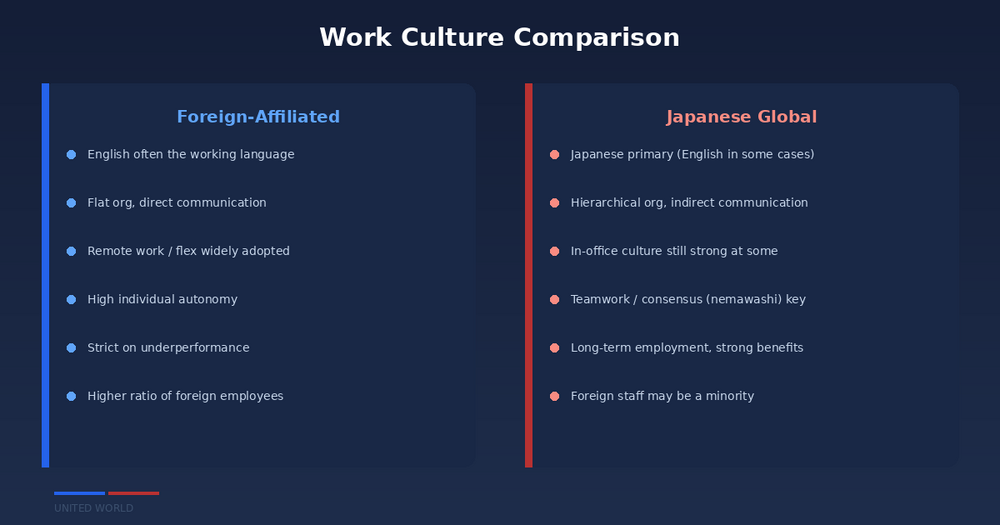
For foreign professionals, corporate culture is the single biggest factor in day-to-day work satisfaction.
Working language
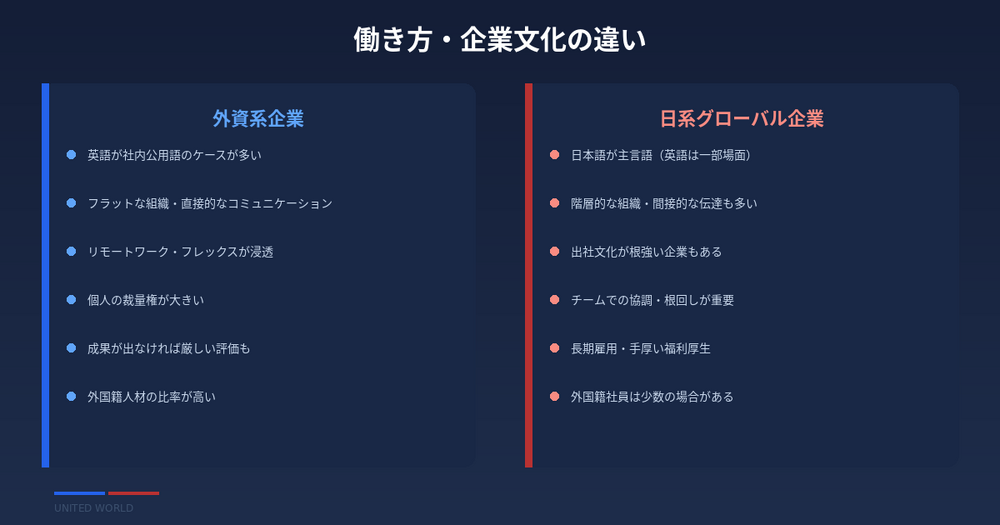
Gaishikei:English is the official or co-official language. Far more accessible for foreign professionals. Nikkei global:Japanese is the primary language. English is used in global divisions or for overseas meetings. Internal emails and approval documents are typically in Japanese.
Decision-making speed
Gaishikei:Top-down. Fast approvals. Frequent pivots. Nikkei global:Bottom-up. Consensus-building (nemawashi) takes time. But once decided, the entire organization moves.
Work style
Gaishikei:Remote work and flex time are well-established. High autonomy as long as results are delivered. Nikkei global:In-office culture persists at some firms, but hybrid models are growing post-COVID.
Foreign employee ratio and inclusivity
Gaishikei:Higher ratio of foreign employees. Diversity is embedded in the organization. Nikkei global:Foreign employees may be a small minority. Risk of being "the only foreigner." However, many firms are actively increasing foreign hires.
キャリアパス・成長機会の比較Career path and growth opportunities comparison
外資系のキャリアパス
特徴: ・専門性を深める方向でキャリアアップ ・昇進は実力ベース。年齢・勤続年数は関係ない ・ジョブディスクリプション(JD)が明確で、自分の役割が分かりやすい ・グローバルモビリティ(海外拠点への異動)の機会がある ・ただし「Up or Out」文化が残る企業もある
Key features: ・Career advancement through deepening specialization ・Promotions are merit-based. Age and tenure are irrelevant ・Job descriptions (JDs) are clear, making your role well-defined ・Global mobility opportunities (transfers to overseas offices) ・"Up or Out" culture exists at some firms
Nikkei global career path
Key features: ・Broad experience through job rotation ・Promotion to management is relatively slow (seniority factor) ・Internal job posting systems are increasingly common ・Overseas assignment opportunities (a unique nikkei strength) ・Stability to build a long-term career at a steady pace
What this means for foreign professionals
Gaishikei is best for those who "want to compete on expertise right now." Skills and results directly translate to compensation, so high performers see outsized returns.
Nikkei global is best for those who "plan to stay in Japan long-term and want diverse experience." Job rotation may seem inefficient, but it builds deep organizational trust and multi-dimensional skills.
Neither is "the right answer." The best choice depends on your career stage and life plan.
自分に合った企業を選ぶためのチェックリストChecklist to find the company that fits you
Use this checklist to determine which type suits you better.
Gaishikei may be right for you if: ・You want to be evaluated purely on results ・You want English as your primary working language ・You thrive in fast-paced environments ・You want to deepen specialization for career growth ・Remote work and flexibility are priorities ・You prioritize high salary over job security
Nikkei global may be right for you if: ・You plan to settle in Japan long-term ・You want to leverage your Japanese language skills (N2+) ・Job security and benefits are important to you ・You want broad experience as a generalist ・You enjoy collaborative, team-based work ・You value retirement benefits and housing support
Many people will check boxes on both sides - and that is perfectly normal. In that case, comparing specific companies is the most effective approach. Even within "gaishikei IT," Google and Oracle Japan have very different cultures. Even within "nikkei global," Rakuten and Toyota operate completely differently.
The key is not the label "gaishikei or nikkei" but "whether that specific company aligns with YOUR career goals and values."
まとめ:ラベルではなく、企業個別で判断しようSummary: Judge by the company, not the label
LanguageGaishikei = English primary / Nikkei = Japanese primary
Job SecurityGaishikei = lower / Nikkei = high
Career PathGaishikei = specialize / Nikkei = rotate
"Gaishikei = good, nikkei = bad" is not accurate. Both have advantages and disadvantages, and the optimal choice depends on your career stage, language ability, and life plan.
"I am not sure which fits me" - if that is you, consulting an agent with access to both types of opportunities is the fastest path to clarity.
Let us find the right company together
United World Inc. is a recruitment agency specializing in career support for foreign white-collar professionals.
United World support includes: ・Extensive listings across both gaishikei and nikkei global companies ・Matching based on your career, language skills, and values ・Interview coaching, salary negotiation, and visa support - all in one place ・Success-fee model - zero cost for job seekers
LinkedIn・履歴書・職務経歴書はどれも任意です。1つでもご提出いただくと、よりスムーズに求人をご紹介できます。LinkedIn, resume and CV are all optional. Sharing any one of them helps us introduce jobs faster.