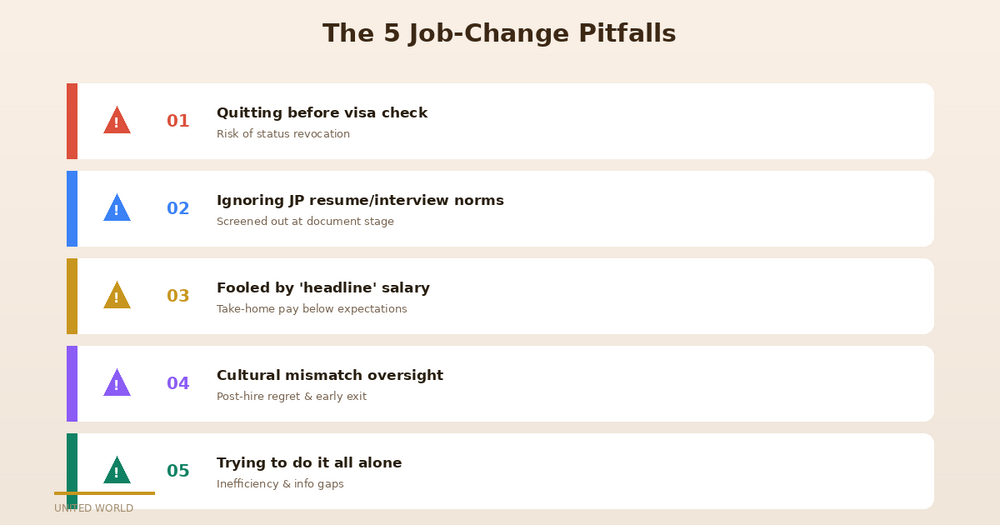
5 Job-Change Pitfalls Foreign Professionals in Japan Must Avoid (And How to Beat Them)

2026.06.18

  • Career Advice
在日外国籍プロフェッショナルが陥る転職の落とし穴5つと回避策

Thinking about changing jobs in Japan? Your drive to advance your career is admirable - but there are hidden pitfalls that can derail your plans if you do not know about them.

Visa revocation risks, the gap between headline and actual salary, Japan-specific interview etiquette - these are traps that simply do not exist in most other countries.

This article covers the 5 most common pitfalls foreign professionals fall into when changing jobs in Japan, with concrete strategies to avoid each one.
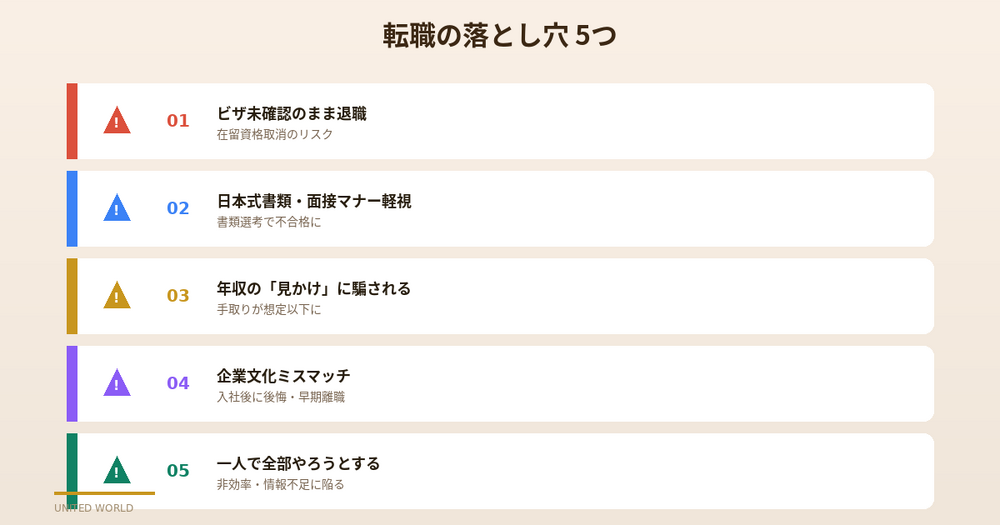
Pitfall #1: Quitting before checking your visa status


This is the most dangerous pitfall. For foreign nationals on a work visa, resigning has direct implications for your immigration status.

Rules you must know:
- If you do not find a new job within 3 months of resignation, your visa may be revoked
- You must notify immigration within 14 days of leaving/joining a company
- If your new job type differs from your visa category, a Change of Status application is required

How to avoid it

Always secure your next job before resigning
- Job hunt while employed - submit your resignation only after receiving an offer
- Verify that the new role falls within your current visa category
- A recruitment agent can advise on visa compatibility as part of their service

Pitfall #2: Underestimating Japanese resume and interview norms


My skills speak for themselves - in Japan, this mindset is a career killer.
Common mistakes:
- Applying with only an English CV - no Japanese rirekisho or shokumu-keirekisho prepared
- Listing responsibilities instead of measurable results
- Unable to articulate why this company when asked
- Saying No questions when given the chance to ask

How to avoid it

Learn the format and follow the minimum rules
- Rirekisho in JIS format; shokumu-keirekisho with quantified achievements
- Get a professional photo taken (suit, neutral background)
- Prepare 3 motivation points, each under 60 seconds
- Prepare at least 2 reverse questions showing you researched the company

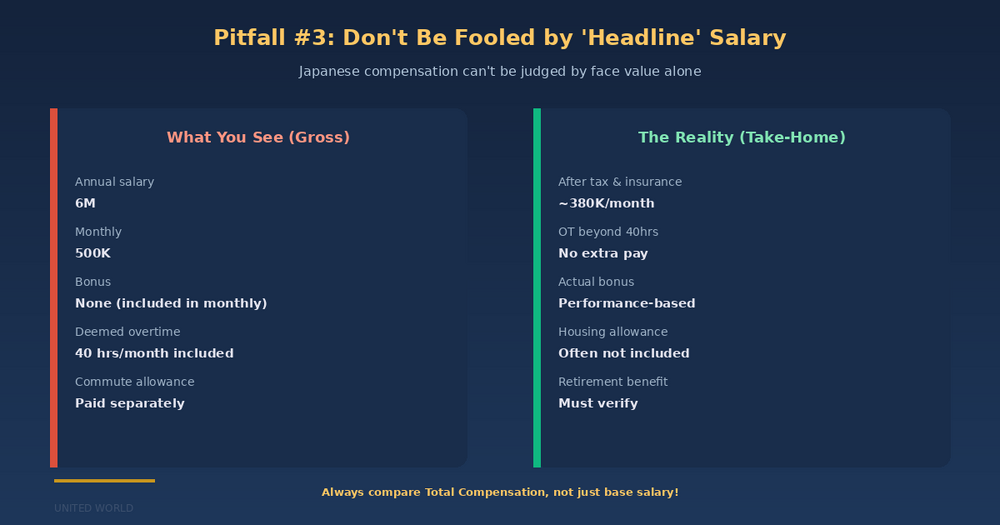
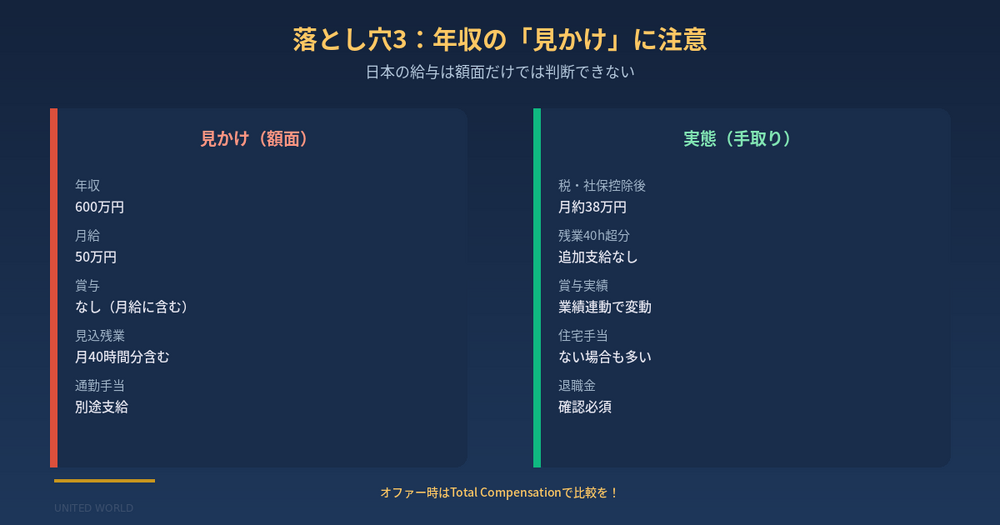
Pitfall #3: Being fooled by headline salary


Japan has a unique compensation structure. If you judge an offer by the gross annual number alone, your take-home pay may be far less than expected.

What foreign professionals often miss:
- Minashi-zangyo (deemed overtime) - 20-45 hrs/month of OT pay may be included in base salary
- Social insurance + tax deductions take roughly 20-30% off gross pay
- Performance-based bonuses can be significantly reduced in a bad year
- Housing allowances are not universal

How to avoid it

5 numbers to verify before accepting any offer
- 1. Monthly pay breakdown (base + fixed OT + allowances)
- 2. Fixed OT hours and what happens when exceeded
- 3. Bonus calculation and actual payouts over past 3 years
- 4. Take-home pay simulation (after tax and insurance)
- 5. Full benefits details

Ask your recruitment agent to build a Total Compensation comparison sheet.

Pitfall #4: Overlooking cultural mismatch


Choosing a job based on salary and title alone can lead to post-hire regret.

Common mismatch patterns:
- Told English environment but Japanese is actually the dominant language
- Told flat organization but seniority hierarchy is entrenched
- Remote OK on paper but manager expects daily in-office presence
- You are the only foreign employee, leading to isolation

How to avoid it

Interviews are for YOU to evaluate the company too
- Use reverse questions to probe culture concretely
- Request an office tour to observe the atmosphere
- Check review sites (OpenWork, Glassdoor) for employee feedback
- Ask your agent: Do foreign professionals stay at this company long-term?

Pitfall #5: Trying to do everything alone


The more experience you have, the more likely you think I can handle this myself.

Problems when going it alone:
- No access to unlisted positions
- Japanese resume quality is poor, leading to rejections
- Visa paperwork errors delay your start date
- You negotiate salary yourself and settle below market rate

How to avoid it

Use a recruitment agent specializing in foreign professionals
Having a Japan market expert in your corner is the single most effective way to avoid all 5 pitfalls.

Job seekers pay nothing (companies pay a success fee), so there is no reason not to use one.

Summary: Know the pitfalls, and job-changing in Japan is not scary


#1 Quitting before visa check - Secure the next role first
#2 Ignoring JP norms - Learn the format and follow rules
#3 Headline salary trap - Compare Total Compensation
#4 Cultural mismatch - Probe with questions and agent intel
#5 Going it alone - Partner with a specialized agent

Every one of these pitfalls is avoidable if you know about it.

Let us avoid the pitfalls together

United World Inc. specializes in career support for foreign white-collar professionals.

United World support includes:
- Proactive support to avoid all 5 pitfalls
- Visa compatibility check and guidance
- Japanese resume review, interview coaching
- Salary negotiation and Total Compensation comparison
- Success-fee model - zero cost for job seekers

Contact United World Inc. here

Services for hiring companies


back to the list

TOP