"I want to change jobs in Japan, but I don't know where to start" — Japan's job market has its own rules and procedures, and many foreign professionals find the process confusing.
Resume formats, interview etiquette, visa transitions, post-resignation filing obligations… Japan's job-changing process has several "unwritten steps" that can trip you up if you don't know about them.
This article provides a complete overview in 5 clear STEPs, organized chronologically — from preparation through onboarding — for foreign white-collar professionals seeking employment in Japan, whether based domestically or overseas.
STEP 1:事前準備――転職活動を始める前にやるべきことSTEP 1: Preparation — What to do before you start job hunting
Success in job hunting depends heavily on the preparation you do before you start applying. Before rushing into applications, organize the following:
1-1. Career inventory
Key items to organize: ・Break down your experience by "function × industry × skills" ・Which experiences are valued in the Japanese market? (Global project experience, management, tech stack, etc.) ・What salary range does your profile command? ・Priority ranking of your preferences (salary, role, location, remote options, visa support)
1-2. Visa status check
Essential pre-move checks: ・Can your current visa status cover the work at your target company? ・When does your residence period expire? (If under 3–4 months, prioritize renewal) ・After changing jobs, you must file a "Notification of Change in Contracting Organization" within 14 days ・If your job type changes, a "Change of Status of Residence" application is required ・If overseas: the company must apply for a Certificate of Eligibility (COE) on your behalf
1-3. Document preparation
Documents needed for job hunting in Japan: ・Rirekisho (Japanese-style resume) — includes photo, formatted template ・Shokumu-keirekisho (work history document) — 2–3 A4 pages, results-focused ・English CV/resume (for foreign-affiliated firms) ・Portfolio / GitHub (for engineers and designers) ・Copy of Residence Card (sometimes requested at interviews)
This is the ideal time to register with a recruitment agent. They can review your documents, provide market intelligence, and dramatically improve your efficiency.
STEP 2:求人リサーチ&応募――自分に合ったポジションの見つけ方STEP 2: Job research & applications — Finding the right positions
With your preparation done, it's time to search and apply. Japan's job market has multiple recruitment channels, each with different strengths.
2-1. Key job search channels
1. Recruitment agents (staffing agencies) ・The #1 recommended channel for foreign professionals ・Access to unlisted positions, schedule coordination, salary negotiation ・Choose agents who can also advise on visa matters ・Free for job seekers (companies pay the fee)
2. Job sites / platforms ・LinkedIn, GaijinPot, Daijob, Indeed Japan and more ・Search and apply directly ・Focus on platforms with English-language search capability
3. Direct recruiting / scouting ・Companies reach out to you directly ・Optimize your LinkedIn profile to increase inbound interest ・For engineers, publishing on GitHub or Qiita helps visibility
4. Referrals ・Referral hires have extremely high success rates in Japan ・Leverage friends, former colleagues, and community connections in Japan ・Simply sharing that you're open to new opportunities can create leads
2-2. Application tips
Key points when applying to Japanese companies: ・Parallel applications to 5–10 companies is standard practice in Japan (not one at a time) ・Customize application materials for each company (especially motivation) ・Foreign firms: resume + cover letter. Japanese firms: rirekisho + shokumu-keirekisho ・Expect screening results within 1–2 weeks of application
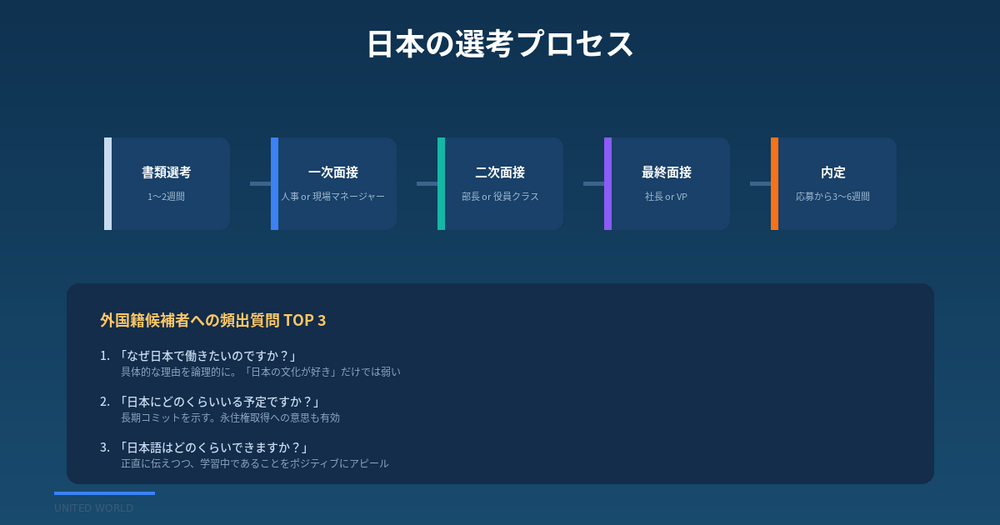
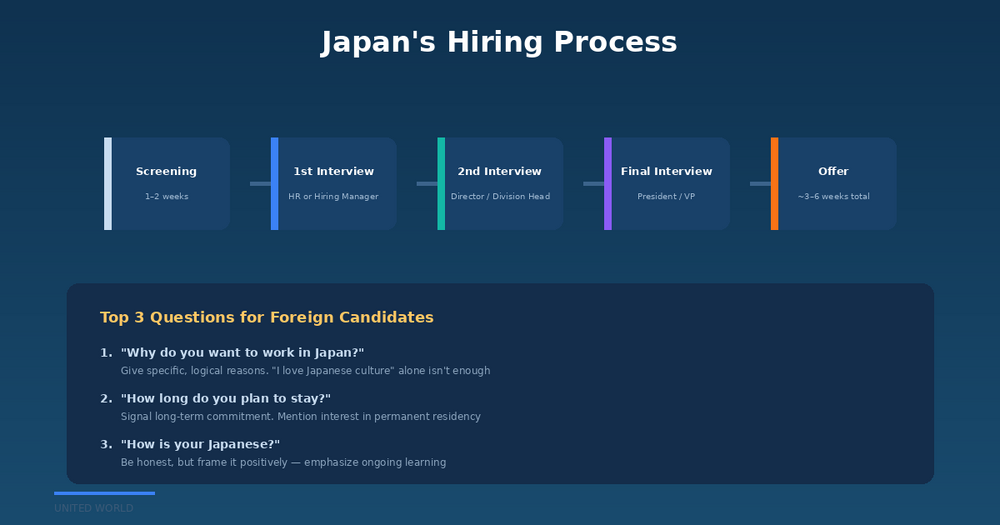
Japan's hiring process typically involves 2 to 4 rounds of interviews. The flow differs between foreign-affiliated and Japanese companies.
Document screening1–2 weeks
1st interview (HR or hiring manager)30–60 min
2nd interview (Director / Division head)30–60 min
Final interview (President / VP)30–45 min
Aptitude test (SPI, etc.)Often given around the 1st interview stage
Time to offer~3–6 weeks from application
3-1. What interviewers evaluate
At Japanese companies: ・"志望動機" (motivation for applying) is the #1 factor — explain logically why THIS company ・Teamwork, cooperativeness, communication skills ・Long-term commitment (will you stay?) ・Japanese language proficiency (business level often expected)
At foreign-affiliated companies: ・Skills match and immediate impact are top priorities ・STAR-format achievement presentations (Situation, Task, Action, Result) ・Culture fit (values alignment) ・English proficiency (presentation and discussion level)
3-2. Common questions for foreign candidates
Frequently asked questions: ・"Why do you want to work in Japan?" (Most common — prepare a specific answer) ・"How long do you plan to stay in Japan?" (Demonstrate long-term commitment) ・"How is your Japanese?" (Be honest, but frame it positively) ・"Why did you leave your previous job?" (Never speak negatively) ・"What are your career goals?" (Talk about growth within this company)
STEP 4:内定〜入社――オファー交渉・ビザ手続き・退職の進め方STEP 4: Offer to start — Negotiation, visa process & resignation
When you receive an offer, review the details carefully before accepting. Japanese offer letters contain items that may differ from what you're used to abroad.
"Minashi-zangyō" (deemed overtime)Check if 20–45 hrs/month of overtime pay is pre-included
Probation periodTypically 3–6 months. Any difference in benefits?
Work styleFull remote / hybrid / fully on-site
Visa sponsorshipWill the company sponsor your visa?
4-2. Visa procedures (by scenario)
Case A: Living in Japan, same job type ・No visa change needed ・File "Notification of Change" with immigration within 14 days of job change ・Obtaining a "Certificate of Authorized Employment" is recommended
Case B: Living in Japan, different job type ・"Change of Status of Residence" application required ・Cannot start working at the new company until approved ・Processing time: ~1–3 months
Case C: Moving to Japan from overseas ・Company files "Certificate of Eligibility (COE)" on your behalf (~1–3 months) ・After COE is issued, apply for a visa at the Japanese embassy in your country ・Upon arrival: register at city hall, receive Residence Card
4-3. Resigning from your current job
Resignation tips for Japan: ・Check your employment rules — 1–3 months' notice is customary in Japan ・Thorough handover is extremely valued in Japanese work culture ・Submit a written resignation letter (退職届) ・Paid leave usage is a legal right, but coordinate with your manager ・Collect your "Rishokuhyō" (separation certificate) and "Gensen-chōshūhyō" (tax withholding slip) after leaving
STEP 5:入社後――最初の90日で信頼を築くオンボーディングSTEP 5: Post-joining — Building trust in your first 90 days
Starting a new job isn't the finish line — it's the starting line of your career. Your actions in the first 90 days will significantly shape your reputation and trajectory.
Day 1 – Week 1
Focus on: ・Give your self-introduction 100% effort (first impressions are critical in Japan) ・Learn every team member's name and role ・Understand office norms (attendance, email etiquette, meeting culture) ・Set up IT tools and internal systems
Month 1
Focus on: ・Align expectations with your manager (what does "success" look like?) ・Practice "Ho-Ren-So" (Report, Contact, Consult) deliberately ・Identify key stakeholders and start building relationships ・Ask questions openly (in Japan, "the ability to ask" is valued)
Month 3 (end of probation)
Focus on: ・Deliver at least one concrete, visible result ・Prepare for your probation review by documenting your contributions ・Share your medium-term career goals with your manager ・Expand your network beyond your immediate team
Note: Dismissal during probation is legally restricted in Japan, but poor performance can affect your post-probation role and compensation. Treat these 90 days not as a "warm-up" but as a full sprint.
まとめ:全体スケジュールの目安Summary: Overall timeline at a glance
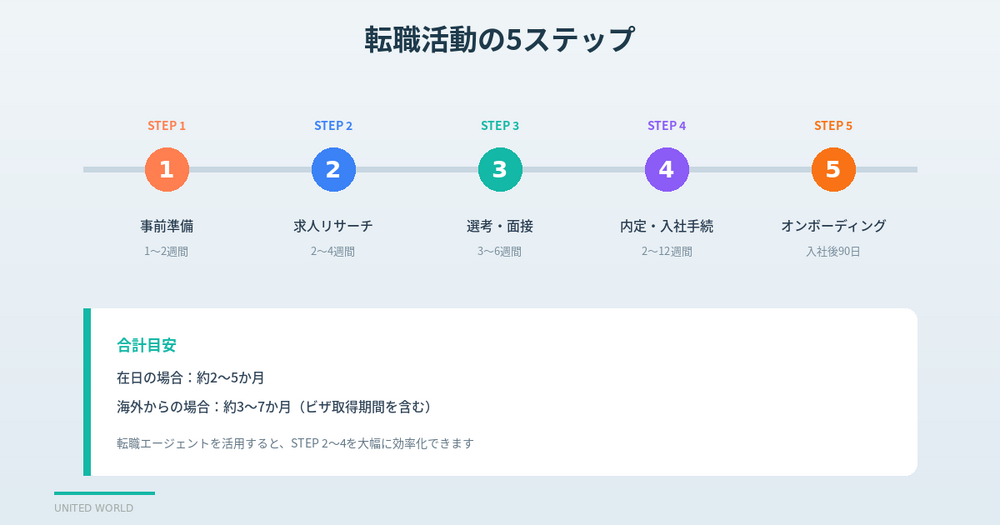
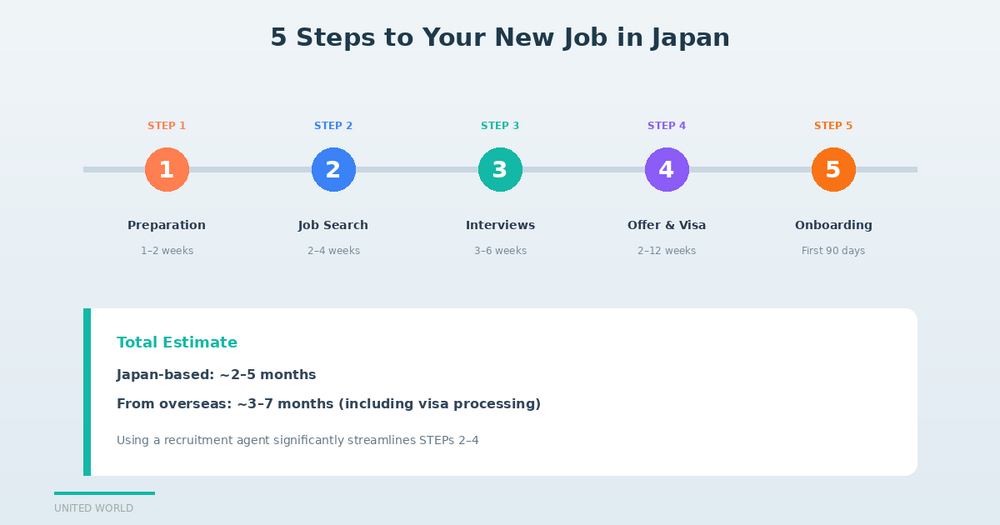
STEP 3: Selection (screening to final interview)3–6 weeks
STEP 4: Offer to onboarding2–12 weeks (visa-dependent)
STEP 5: Post-joining onboardingFirst 90 days
Total estimate~2–5 months (Japan-based) / 3–7 months (from overseas)
Job hunting in Japan will produce results when you follow the right steps in the right order. But navigating Japan-specific rules — visa procedures, resume formats, interview etiquette, resignation customs — alone is no small feat.
"I want to job-hunt efficiently" / "I need visa guidance too" — if that sounds like you, working with a partner who knows Japan's job market inside-out will make all the difference.
Considering a career move in Japan?
United World Inc. is a recruitment agency specializing in career support for foreign white-collar professionals — including AI engineers, IT engineers, overseas sales, bilingual talent, and biotech professionals.
United World's support includes: ・End-to-end support across all 5 STEPs ・Resume and work history document preparation, interview coaching ・Salary negotiation and offer review ・Work visa and Highly Skilled Professional visa support ・Post-placement follow-up — all in one place ・Success-fee model — zero cost for job seekers
LinkedIn・履歴書・職務経歴書はどれも任意です。1つでもご提出いただくと、よりスムーズに求人をご紹介できます。LinkedIn, resume and CV are all optional. Sharing any one of them helps us introduce jobs faster.