"Japanese companies promote by seniority, not merit" — this perception of Japan's employment system persists among professionals abroad.
But today, Japan's career market is in the midst of its most significant structural transformation since World War II. The shift from "membership-based employment" — built on seniority, lifetime employment, and generalist career paths — toward "job-based employment," where compensation is tied to specific roles, is accelerating at major firms like Hitachi, Fujitsu, KDDI, Sony, and Shiseido.
In August 2024, Japan's government (Cabinet Secretariat, METI, and MHLW) published its "Job-Based Employment Guidelines", documenting 20 pioneering companies' approaches — a clear signal of national commitment to this transition.
This article explains the differences between membership-based and job-based employment, the latest adoption data, and what this shift means practically for foreign professionals considering a career in Japan.
メンバーシップ型雇用とは? ――日本独自の「人ベース」の仕組みWhat is membership-based employment? Japan's unique 'person-based' system
Membership-based employment has been the foundation of Japanese hiring since the postwar era. Understanding this system is the first step toward building a successful career in Japan.
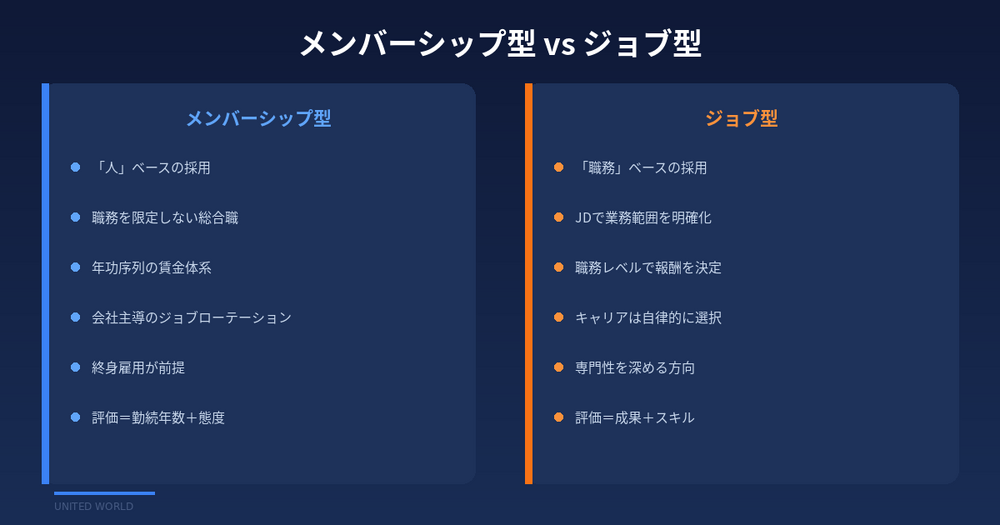
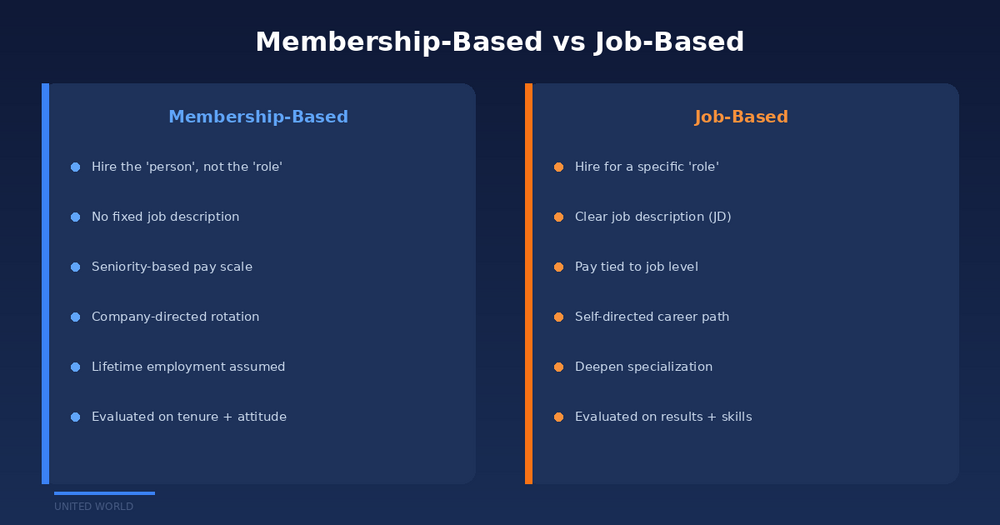
Key features of membership-based employment: ・Job duties are not defined at hiring ("Sogo-shoku" / generalist track — your department is decided after joining) ・Company-directed job rotation (transferred to a new department every few years) ・Seniority-based pay (salary increases with years of service) ・Long-term employment assumed (lifetime employment culture) ・Implicit expectation to accept transfers and relocations
Under this system, "how long you've been at the company" historically mattered more than "what you can do."The standard career path was: join straight from university, follow the company-designed career track, and advance gradually over decades.
Watch out for (as a foreign professional): ・You may be hired as a "specialist" but treated as a "generalist" ・Job descriptions (JDs) often don't exist — your duties may be vague ・"Flexible scope" can mean unexpected tasks outside your expertise ・Evaluation criteria may be opaque, favoring "attitude" and "team contribution" over measurable results
That said, membership-based employment has genuine advantages: job security, structured long-term development, and broad skill-building through rotation — benefits that can be valuable for foreign professionals too.
ジョブ型雇用とは? ――グローバルスタンダードへの回帰What is job-based employment? The shift toward a global standard
Job-based employment clearly defines each role's responsibilities and matches people to specific positions. It's the dominant model in Western countries and the global standard.
Key features of job-based employment: ・Job descriptions (JDs) specify duties, scope, and required skills ・Compensation is tied to the "job," not the "person" ・Same role = same pay, regardless of age or tenure ・Career paths are self-directed (you choose your next move, not the company) ・Advancement comes through deepening specialization
An important nuance: Japan's version is "Japanese-style job-based employment" — not a carbon copy of the Western model. Japan's strict labor protections mean that losing your job function doesn't automatically mean losing your position.
How "Japanese-style" job-based differs from the West: ・Employment stability is preserved (the job security of membership-based is retained) ・Most companies adopt a "hybrid" — not pure job-based ・Internal job posting systems let employees apply for new roles ・Seniority elements are phased out gradually, not eliminated overnight
For foreign professionals, job-based companies are significantly easier to navigate: duties are clear, performance is measured, and expertise is properly reflected in compensation.
【2025-2026年最新データ】日本企業のジョブ型導入はどこまで進んだか2025–2026 data: How far has Japan's job-based transition progressed?
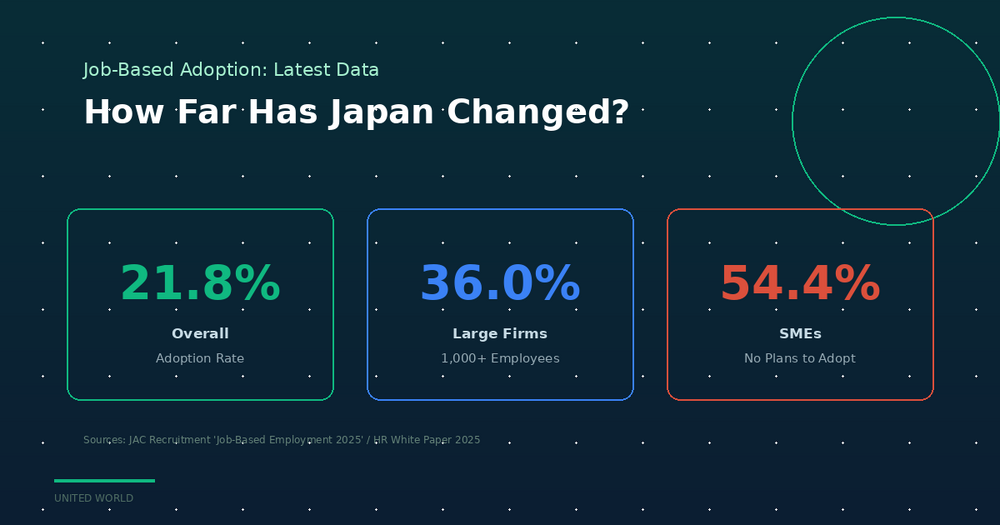
Job-based adoption is accelerating at large firms, but across Japan as a whole, it remains a work in progress. Here's the latest data:
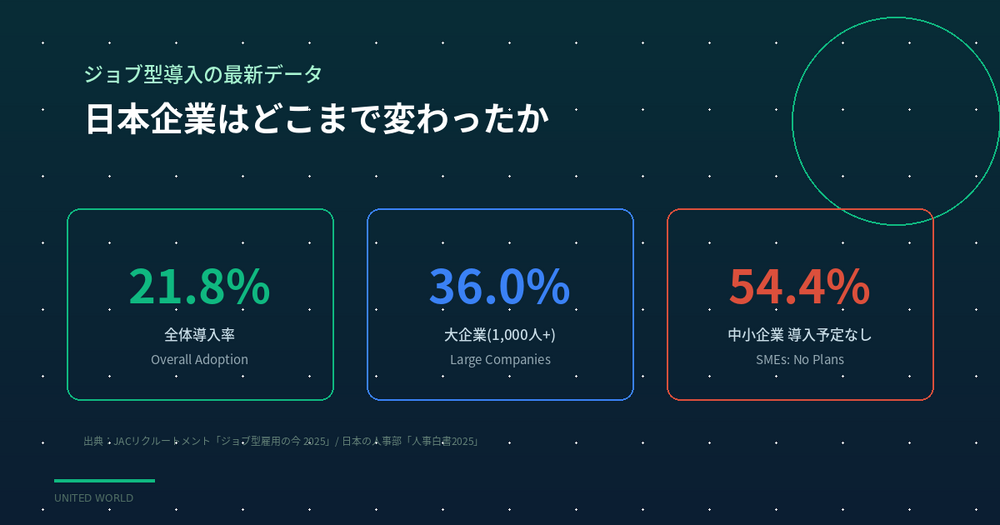
Overall job-based adoption rate~21.8%
Companies with 1,000+ employees36.0% (+6.5pts YoY)
Companies with <100 employees11.0%
Considering adoption~30–45%
SMEs with no plans to adopt54.4%
Major companies that have adopted job-based systems
Hitachi: Rolled out to executives in 2020, all employees in 2022. Eliminating uniform starting salaries from FY2026— new grads will be paid by job level. Mid-career hiring up 3.7x since 2018.
Fujitsu: Introduced for ~15,000 managers in 2020. Created a "Global Role Framework" — a unified job classification system used worldwide.
KDDI: Applied to mid-career hires from 2020, expanded to 2,400 managers in 2021. Abolished uniform starting salaries and defined JDs for 30 job categories.
Sumitomo Mitsui Card: Launched a job-based HR system for specialist roles in October 2025. Compensation tied to market value— no automatic annual raises.
However, among companies that have adopted job-based systems, about 43% report that the system "has been introduced company-wide but is not yet functioning adequately." Full transition remains rare — most are in a "hybrid" phase.
外国籍プロフェッショナルにとって何が変わるのかWhat does this mean for foreign professionals?
Japan's job-based transition is overwhelmingly positive news for foreign talent. Here's how it impacts you:
1. Your expertise will be properly valued
Under membership-based employment, "how long you've been at the company" drove evaluations. Under job-based employment, "what you can do" becomes the primary metric. Skills and experience gained overseas will be recognized and rewarded in Japan.
2. The seniority "ceiling" is lifting
Historically, promotions followed a rigid timeline based on years of service — disadvantaging mid-career foreign hires. Job-based systems enable role-based compensation, meaning talent and results matter more than tenure.
3. Clear job descriptions = clear expectations
The risk of being asked to do "a little bit of everything" diminishes. Your role, responsibilities, and evaluation criteria are documented, bringing much-needed transparency.
4. Mid-career hiring is surging
Companies shifting to job-based employment need external specialists. Hitachi's mid-career hiring has increased 3.7x since 2018. The number of positions open to foreign professionals is growing.
5. Membership-based companies still offer opportunities
Not every Japanese company is going job-based. ~54% of SMEs have no plans to adopt it. Many membership-based companies actively seek foreign talent. The key is understanding which system your target company uses before you apply.
制度別・日本企業で成功するための実践ガイドPractical guide: How to succeed under each system
Tailoring your approach to the company's employment system is the key to career success in Japan.
Succeeding at a job-based company
1. Study the JD thoroughly Before applying, analyze the job description in detail. Prepare concrete examples showing how your skills and experience align with each requirement.
2. Negotiate compensation based on market value Job-based companies set pay by market rates. Research salary benchmarks for your role and industry, and negotiate with data.
3. Own your career development In a job-based system, career growth is self-directed. Actively pursue internal job postings, upskilling programs, and stretch assignments.
Succeeding at a membership-based company
1. Master "Ho-Ren-So" (Report, Contact, Consult) Process matters as much as results in membership-based companies. Increase your communication frequency with managers and teammates.
2. Embrace job rotation positively A transfer isn't a demotion — it's development. Multi-department experience builds trust and influence within the organization.
3. Learn the unwritten evaluation criteria "How much you contributed to the team" and "whether you helped others in tough situations" are evaluated — even when not in any JD. Ask your manager or senior colleagues directly.
Regardless of which system you're in, the most important thing is "understanding which system you're operating under". Pushing your home country's work style without adapting creates friction. Understanding and adapting to the system unlocks your potential in Japanese companies.
まとめ:日本の雇用は「ハイブリッド」の時代へSummary: Japan's employment is entering a 'hybrid' era
Japan's career market is in transition from membership-based to job-based employment. Large companies are leading the shift, but nationwide adoption sits at roughly 21.8%. Over half of SMEs have no plans to change.
Key takeaways: ・Membership-based = "person-based." Seniority, job rotation, and lifetime employment ・Job-based = "role-based." JDs define scope; performance and expertise drive evaluation ・Japan's reality is "hybrid" — most companies blend elements of both ・Large-company adoption at 36% (+6.5pts YoY) and growing steadily ・For foreign professionals, the trend is clearly positive: expertise is valued, mid-career hiring is up
The key is not to judge Japan's system as "good or bad," but to understand how it works and choose companies that match your strengths and career goals.
"Which companies are job-based?" "Are there roles that match my skills?" — These questions are best answered by a partner with deep expertise in Japan's employment landscape.
Considering a career in Japan?
United World Inc. is a recruitment agency specializing in career support for foreign white-collar professionals — including AI engineers, IT engineers, overseas sales, bilingual talent, and biotech professionals.
United World's support includes: ・Matching foreign professionals with the right companies — whether job-based or membership-based ・Resume preparation, interview coaching, and salary negotiation — all in one place ・Work visa and Highly Skilled Professional visa application support ・Ongoing post-placement follow-up ・Success-fee model — zero cost for job seekers
"I don't understand Japan's employment systems" / "I want to know if my skills are in demand" — we'd love to hear from you.
LinkedIn・履歴書・職務経歴書はどれも任意です。1つでもご提出いただくと、よりスムーズに求人をご紹介できます。LinkedIn, resume and CV are all optional. Sharing any one of them helps us introduce jobs faster.