"If I'm going to build my career in Asia, which country should I choose?" — In answer to this question, a rapidly growing number of foreign professionals are choosing Japan.
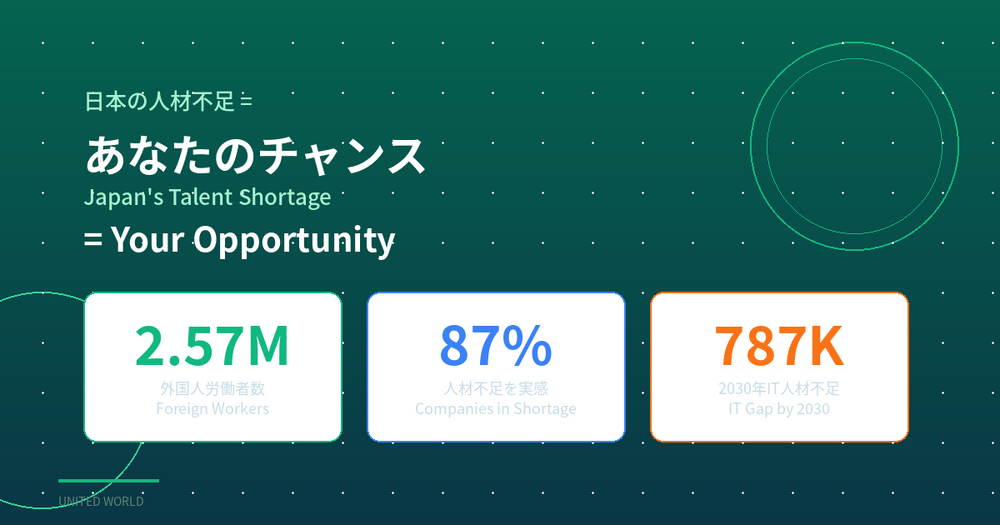
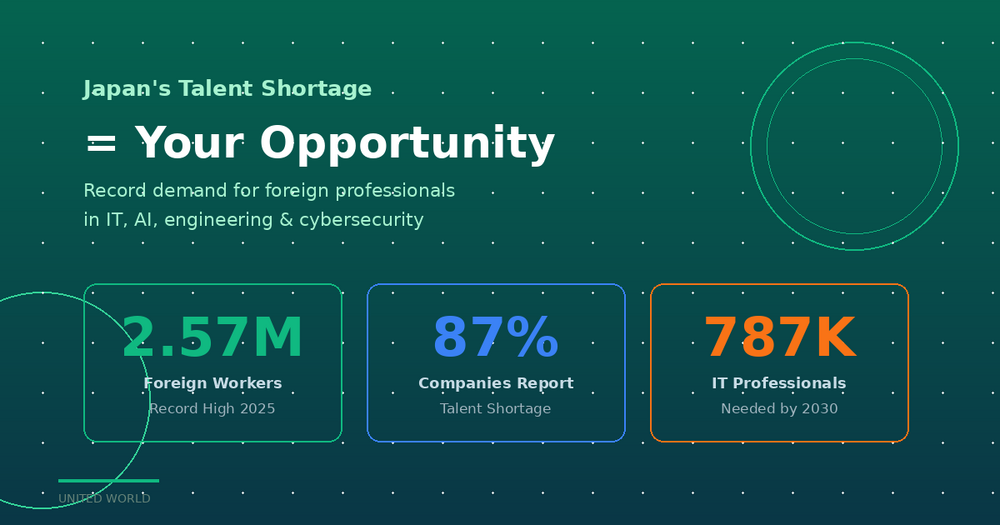
According to Japan's Ministry of Health, Labour and Welfare, the number of foreign workers in Japan reached approximately 2.57 million as of October 2025, marking a record high for the 13th consecutive year. This figure has roughly tripled from about 900,000 in 2015. Additionally, data from the Immigration Services Agency shows that Japan's total foreign resident population exceeded 4.12 million by the end of 2025 — another all-time record.
What's driving this rapid growth? In this article, we break down five compelling reasons why foreign white-collar professionals should choose the Japanese market now, backed by the latest data.
理由1:深刻な人材不足が生む、かつてないチャンスReason 1: An unprecedented talent shortage creating massive opportunity
Japan is experiencing population decline and aging at a pace virtually unmatched globally. People aged 65 and older now account for 29.3% of the total population (approximately 36.25 million), and the working-age population continues to shrink.
The talent shortage in numbers: ・87% of companies report difficulty finding talent (2025 survey) ・Japan faces a projected shortfall of up to 787,000 IT professionals by 2030 ・In 2023, 260 companies went bankrupt specifically due to labor shortages ・The government has raised the mandatory retirement age to 65 (effective April 2025)
For foreign professionals, this represents an unprecedented window of opportunity. Companies are actively hiring regardless of nationality, with demand for foreign talent surging particularly in IT, engineering, AI, and cybersecurity.
In the past, Japan had a reputation for "no Japanese, no job" hiring practices. Today, companies are actively adapting their hiring processes to accommodate foreign talent— introducing English-language interviews, comprehensive visa support, and multilingual onboarding programs. The hiring landscape has transformed dramatically.
理由2:世界最速クラスの永住権取得ルートReason 2: One of the world's fastest paths to permanent residency
To attract highly skilled foreign professionals, the Japanese government has established the Highly Skilled Professional (HSP) Visa — a unique points-based immigration system rarely seen elsewhere in the world.
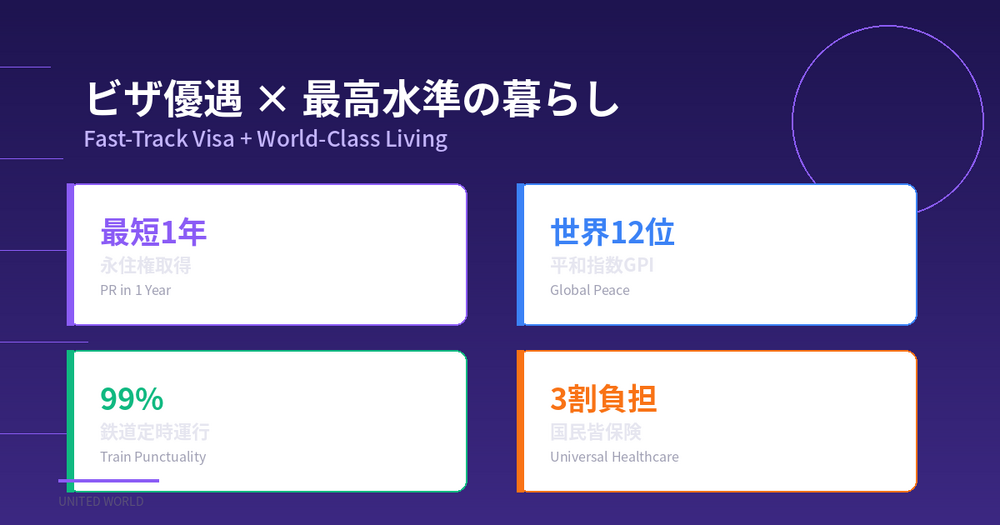
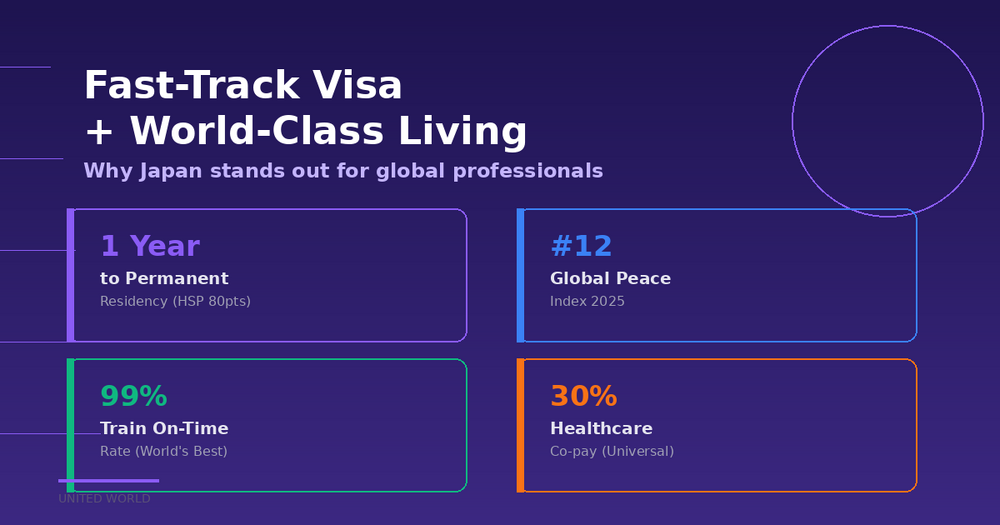
Key benefits of the HSP Visa: ・Qualify with 70+ points; apply for permanent residency in as little as 1 year with 80+ points ・Spouse can work full-time (unlike standard dependent visas) ・Parents may accompany you under certain conditions (e.g., if you have children under age 7) ・Domestic worker accompaniment permitted (subject to income requirements) ・Priority processing for immigration applications
In 2023, Japan also introduced the "J-Skip" visa pathway, allowing individuals with an annual income of ¥20 million+ (or a master's degree + ¥10 million+ income) to obtain HSP status without the points calculation.
The number of HSP visa holders has surged approximately 20-fold in five years — from 592 to over 12,227— a clear indicator of how seriously the Japanese government is working to attract global talent.
For comparison, permanent residency in Singapore or the United States typically takes 5 to 10+ years. Japan's HSP visa offers a remarkably fast track — as little as one year to permanent residency eligibility for those who qualify.
理由3:世界トップクラスの安全性と生活の質Reason 3: World-class safety and quality of life
Career decisions aren't made on compensation alone. Safety, healthcare, infrastructure, and livability are critical factors when choosing where to build a long-term life.
Global Peace Index (GPI) 2025Ranked 12th globally, 3rd in Asia-Pacific
Family travel safety & conveniencePerfect score of 100/100 (2025 study)
Universal healthcare systemSelf-pay burden: 30% of medical costs
Crime rateRoughly 1/10 of the U.S., 1/5 of the U.K.
While Tokyo has a reputation for high rent, compared to New York, London, or Singapore, equivalent-quality housing can be 20–40% cheaper. Cities like Osaka, Nagoya, and Fukuoka offer even lower costs of living.
For those relocating with family, Japan's education environment is a major draw. Public schools are free to attend. International schools are well-established in Tokyo, Osaka, and beyond. Healthcare is equally compelling — under universal coverage, high-quality medical services are available at low out-of-pocket costs.
Japan isn't just a great place to work — it's one of the best places in the world to raise a family and live with peace of mind.
理由4:上昇トレンドにある賃金と待遇Reason 4: Wages and compensation on a clear upward trend
"Japanese salaries are low" — that used to be the conventional wisdom. But in recent years, Japanese wages have entered a clear upward trajectory.
Wage growth data: ・2025 spring labor negotiations secured average raises of 5.46% (highest in 30 years) ・55% of companies plan further wage increases in 2026 ・Foreign-affiliated tech companies (Google, Amazon, Microsoft, etc.) pay at global market rates ・Foreign IT engineers in Japan earn approximately 60% more than the domestic average in many cases
Junior Engineer (1–2 years)¥5M–7M
Mid-level Engineer (3–5 years)¥6M–9M
Senior Engineer / Tech Lead¥8M–12M
Manager / Director¥10M–15M
Foreign-affiliated Tech (Senior)¥12M–20M+
Equally important is disposable income relative to salary. A mid-level engineer earning ¥6 million annually in Tokyo takes home approximately ¥380,000/month after taxes and insurance. After typical expenses (rent ~¥93,000, food, transportation), roughly ¥287,000 remains each month — providing significant capacity for savings or remittances.
理由5:テック産業の急成長と外国籍人材への門戸開放Reason 5: A booming tech industry with doors open to foreign talent
Japan's tech industry is at a major inflection point. The IT services market reached approximately $93.7 billion in 2025, with AI, cloud computing, and DX (Digital Transformation) driving growth.
Tailwinds for foreign engineers: ・Massive semiconductor investment (TSMC Kumamoto plant operational; 2nd and 3rd plants planned) ・Accelerating data center investment by major foreign firms (Google, Microsoft, Amazon, etc.) ・GX (Green Transformation) attracting new capital flows ・The software market alone is valued at approximately $24.6 billion (2025).
As investment expands, positions that don't require Japanese language skills are steadily increasing. At foreign-affiliated tech companies and global startups in particular, English is often the working language, and an expanding number of roles are open to candidates without Japanese proficiency.
Direct recruiting via GitHub and LinkedIn has also intensified. It's increasingly common for overseas-based professionals to receive job offers and relocate to Japan. Many companies now offer visa sponsorship and relocation packages as standard practice.
In a country projected to face a shortfall of up to 787,000 IT professionals by 2030, foreign engineers are no longer a "Plan B" — they're becoming core to the workforce strategy.
まとめ:日本は「選ばれる市場」になりつつあるSummary: Japan is becoming a market of choice
Here's a recap of the five reasons covered in this article:
1. Critical talent shortage → Demand for foreign talent at historically high levels 2. One of the fastest PR paths globally → HSP visa enables PR application in as little as 1 year 3. World-class safety and quality of life → Top-tier public safety, healthcare, and infrastructure 4. Rising wages → Biggest wage increases in 30 years; foreign talent compensation trending up 5. Booming tech industry → Massive investment in AI, semiconductors, and cloud expanding job opportunities
Of course, working in Japan comes with its challenges — language barriers, unique business culture, and housing hurdles, among others. However, the opportunities available in Japan today more than outweigh these challenges.
"I'm interested in Japan, but I don't know where to start" — if that sounds like you, the first step is to connect with a trusted partner who can guide you.
Considering a career in Japan?
United World Inc. is a recruitment agency specializing in career support for foreign white-collar professionals — including AI engineers, IT engineers, overseas sales, bilingual talent, and biotech professionals.
United World's support includes: ・Career support for foreign professionals, whether based in Japan or overseas ・End-to-end matching, interview coaching, and salary negotiation ・Work visa and Highly Skilled Professional visa application support ・Post-placement follow-up — all in one place ・Success-fee model — zero cost for job seekers
"I want to explore working in Japan" / "I want to know if there are roles that match my experience" — we'd love to hear from you.
LinkedIn・履歴書・職務経歴書はどれも任意です。1つでもご提出いただくと、よりスムーズに求人をご紹介できます。LinkedIn, resume and CV are all optional. Sharing any one of them helps us introduce jobs faster.